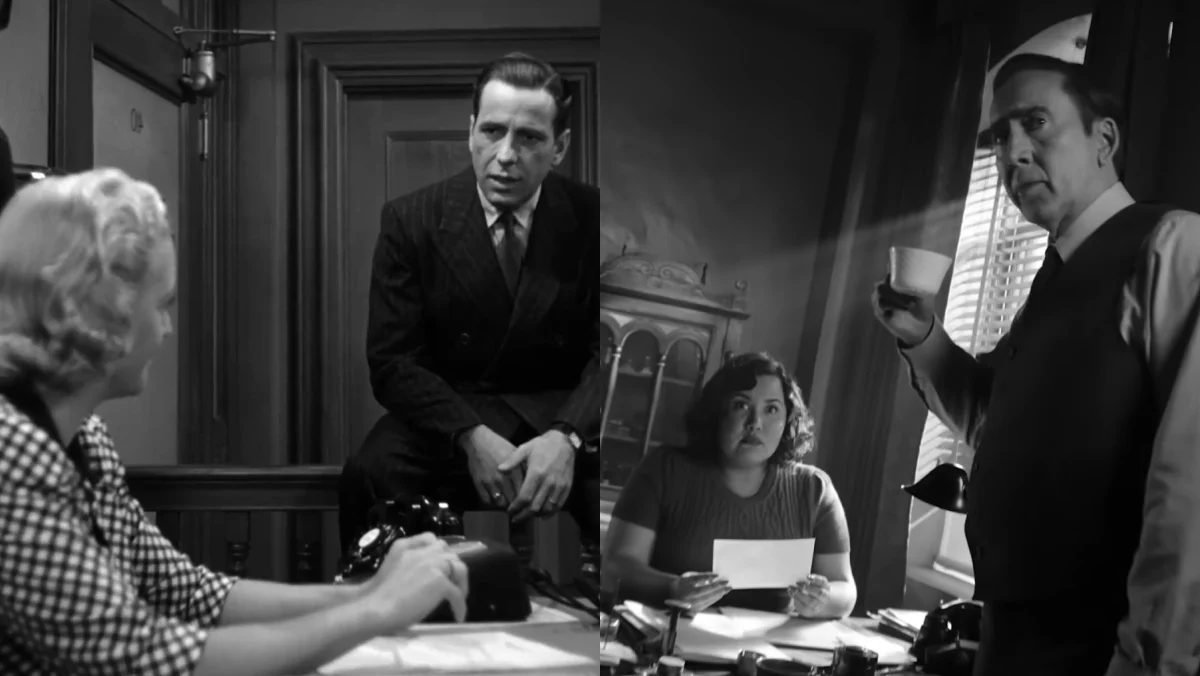
As the creator of Noirvember, the first few trailers and making-of videos for Spider-Noir, the new live-action series starring Nicolas Cage, made my noir senses immediately start to tingle. Inspired in part by the pulp crime novels of the 1930s by the likes of Raymond Chandler and Dashiell Hammett, series executive producers Phil Lord and Christopher Miller have also spoken about the heavy influence of 1940s and 1950s film noir on the look and feel of the show.
Although the show will be released in both “True-Hue,” a riff on Technicolor inspired by the early Dick Tracy comics, and traditional black-and-white, the influence of film noir is apparent any way you decide to watch the show. Here are the classic noir film references I’ve sussed out so far in Spider-Noir.
The Maltese Falcon (1941)

The second adaptation of Dashiell Hammett’s 1930 novel of the same name, this San Francisco set John Huston flick starring Humphrey Bogart as the iconic gumshoe Sam Spade is largely considered a bridge between the more action based crime films of the 1930s and the psychologically darker films that would become known film noir. It also was a major influence on the series.
Nicolas Cage told Esquire that his performance as Ben Reilly/The Spider is “70 percent Humphrey Bogart, and 30 percent Bugs Bunny.” Showrunner Oren Uziel also shared that Reilly’s secretary Janet (Karen Rodriguez) was inspired by Spade’s secretary Effie, played by Lee Patrick. Another fun connection: Jack Huston, who plays baddie Flint Marko / Sandman, is director John Huston’s grandson.
Murder, My Sweet (1944)

Directed by Edward Dmytryk, this 1944 noir is the first film to feature Raymond Chandler’s iconic hard-boiled detective Philip Marlowe. The character appeared in seven novels penned by the author. Although many readers may remember Bogart’s performance as the world-weary private eye in Howard Hawks’ 1946 adaptation of The Big Sleep, for many this film’s star, Dick Powell, is the ultimate filmic embodiment of Marlowe. Murder, My Sweet, which is an adaptation of Chandler’s 1940 novel “Farewell, My Lovely,” finds Marlowe mixed up in a convoluted plot that includes eccentric rich people, night clubs, and even a trip to the sanatorium.
Crime Wave (1954)

Although Brendan Gleeson’s Silvermane is an classic Irish mob boss, his character as portrayed in the teasers visually riff on several different kinds of film noir motifs. In this shot he is framed inside a moving car just like Sterling Hayden in Andre de Toth’s Crime Wave (1954). In the film Hayden plays Detective Lieutenant Sims, a hard-nosed detective on the haunt for escaped convicts who have broken out of San Quentin. The film directed by Andre de Toth is notable for its many location shots in and around Los Angeles, Burbank and Glendale in Southern California.
Laura (1944)

In one shot of a Spider-Noir teaser, a portrait of Silvermane goes up in flames. The portrait’s gilt frame bares a striking resemblance to the most haunting portrait in all of film noir—Laura Hunt (Gene Tierney) in Otto Preminger’s Laura (1944). An adaptation of Vera Caspary’s 1943 novel of the same name, Laura tells the story of a young woman who is presumed murdered. It follows the detective (Dana Andrews) who, while tasked with solving her murder, grows obsessed with her portrait, and the two men (Clifton Webb, Vincent Price) who each think they know her best. Otto Preminger’s film was also a major inspiration for David Lynch and Mark Frost’s landmark television series Twin Peaks.
Gilda (1946)

Describing Spider-Noir‘s requisite femme fatale Cat Hardy (Li Jun Li), Uziel has said that Rita Hayworth was a major inspiration, along with Lauren Bacall, Anna May Wong, and Kim Basinger from Curtis Hanson’s L.A. Confidential. Hayworth played the titular femme fatale in Charles Vidor’s Gilda, one of the silver screen’s greatest bad romances.
In the film, Hayworth plays a sensual chanteuse and wife of a casino owner (George Macready) in Buenos Aires, Argentina whose murky past comes back to haunt her after her husband hires her old lover Johnny (Glenn Ford). Hayworth’s introduction, in which she flips her hair and coyly replies “who me?” when asked if she’s decent took on a whole new level of cultural cache when it was used in a pivotal scene in Frank Darabont’s The Shawshank Redemption.
Road House (1948)

While not mentioned by Uziel, I noticed an homage to another of the era’s great femme fatales: Ida Lupino. Along with being a pioneering filmmaker in her own right (you must watch her 1953 desert noir The Hitch-Hiker), Lupino carved a space as a brassy leading lady in a plethora of noir. Her turn as a torch singer caught in a love triangle between the owner of a bowling alley (Richard Widmark) and his boyhood friend (Cornel Wilde) which escalates towards attempted murder in Jean Negulesco’s melodramatic noir Road House is one of her best, most underrated performances.
The Lady From Shanghai (1947)

One of the most overt homages amongst the earlier teaser material is this shot in which the frame itself appears to be broken glass, which is a nod to Orson Welles’ The Lady From Shanghai. In that film, Welles stars opposite his then-wife Rita Hayworth, as an Irish sailor named Michael O’Hara who is hired by her much-older husband Arthur Bannister (Everett Sloane) to man their yacht as they cruise from New York City to San Francisco via the Panama Canal.
O’Hara soon finds himself set up as a patsy when Bannister suggests he help him fake his own death. Like many of Welles’ films made in Hollywood, the film was butchered by the studio before its initial release. However, despite the studio’s interference, it remains one of the bleakest, and most dreamlike films of its era.
Dark Passage (1947)

Getting back into the world of Bogart noir, Spider-Noir is also rife with homages to Delmer Daves’ surreal San Francisco set noir Dark Passage. Adapted from the book of the same name by David Goodis, the first few scenes of the film are from POV of Bogart’s character, Vincent Parry, a convicted wife-killer who has escaped from San Quentin Prison in order to prove his innocence.
After being helped by a wealthy dilettante (Lauren Bacall), Parry makes his way to San Francisco where he undergoes plastic surgery in order to alter his appearance so he can continue to search for his wife’s true killer.
The Naked City (1948) / The Woman on Pier 13 (1949) / Pickup On South Street (1953)

The shot where Reilly waits on a doc had me thinking of several noir films that utilize the waterfront. Jules Dassin’s The Naked City was filmed almost completely on location in and around New York City, including in an evocative early sequence where two men who have just murdered a woman in her bathtub get into a tussle when one of them becomes conscience-stricken while drunk ending with the other throwing him into the East River.
In Robert Stevenson’s The Woman on Pier 13, the docks of San Francisco prove to be the location of a secret Communist headquarters. Lastly, in Samuel Fuller’s Pickup On South Street, small-time crook Skip McCoy (Richard Widmark), who lives out on the docks, finds himself caught up in a Communist plot involving stolen microfilm after he steals a wallet from a woman named Candy (Jean Peters).
Phantom Lady (1944)

This shot of a horn player is framed almost exactly like an identical shot in Robert Siodmak’s Phantom Lady, which was an adaptation of a novel by prolific writer Cornell Woolrich (published under the pseudonyms William Irish). The film stars Alan Curtis as a man named Scott, who finds himself accused of murdering his wife. When he cannot produce the “phantom lady” he picked up in a bar to prove his alibi, he is sentenced to death.
That’s when his loyal secretary Carol (Ella Raines) sets out to prove his innocence, joined by his buddy Jack (Franchot Tone), who has just returned from South America. Along with including one of the great – and strangest – supporting turns from noir staple Elisha Cook, Jr., this Manhattan set mystery is also notable for being produced by Joan Harrison. She was one of the few female producers working during the classic Hollywood studio era.
White Heat (1949)

I don’t know why this character is on fire, but I do know this is most definitely an homage to the final sequence in Raoul Walsh’s White Heat. In the film James Cagney stars as psychotic criminal Arthur “Cody” Jarrett, who is extremely close to his mother (Margaret Wycherly). After evading the law for most of the film, Cody eventually finds himself locked up. While in prison, his mother passes away, his violent outbreak gets him transferred to an asylum, where he soon escapes.
When the law finally catches up with him again, he climbs to the top of a Horton sphere, which is set on fire after being shot by the police. As the flames begin to engulf him, he shouts “Made it, Ma! Top of the world!” In 2005, Cagney’s iconic delivery of this line was voted to the 18th spot in AFI’s 100 Years…100 Movie Quotes.
Sweet Smell of Success (1957)

One of the great big bads from all of the classic noir era actually came towards its end: Burt Lancaster as sadistic columnist J. J. Hunsecker in Alexander Mackendrick’s Sweet Smell of Success, adapted from a novelette by Ernest Lehman. One of the most powerful men in not just New York City, but the whole United States, Hunsecker wields the power of his column to get whatever it is he wants, controlling the lives of everyone around him, including his kid sister (Susan Harrison) and rat bastard press agent Sidney Falco (Tony Curtis).
Largely shot on location, the neon lights of New York City never looked better than it does when warmed in the warm glow of James Wong Howe’s luminous black-and-white cinematography.
Sunset Boulevard (1950)

Lastly, this image The Spider floating face down in water is a direct reference to the opening sequence of Billy Wilder’s Sunset Boulevard, in which down-and-out screenwriter Joe Gillis (William Holden) narrates the story of his own death after he’s found face down in the pool of reclusive silent film star Norma Desmond (Gloria Swanson). Along with Swanson’s Oscar-nominated performance, the film features cameos from several silent era luminaries, including director Cecil B. DeMille, gossip columnist Hedda Hopper, and actors Buster Keaton, H. B. Warner, and Anna Q. Nilsson.
One of the strangest and most unique entries from the classic noir era, this is a deliciously nasty poison pen letter to an industry (Hollywood) that pulls people in, uses them up, and then spits them back out without any mercy or grace.
The post Every Classic Noir Film Reference in SPIDER-NOIR appeared first on Nerdist.
This articles is written by : Fady Askharoun Samy Askharoun
All Rights Reserved to Amznusa www.amznusa.com
Why Amznusa?
AMZNUSA is a dynamic website that focuses on three primary categories: Technology, e-commerce and cryptocurrency news. It provides users with the latest updates and insights into online retail trends and the rapidly evolving world of digital currencies, helping visitors stay informed about both markets.
