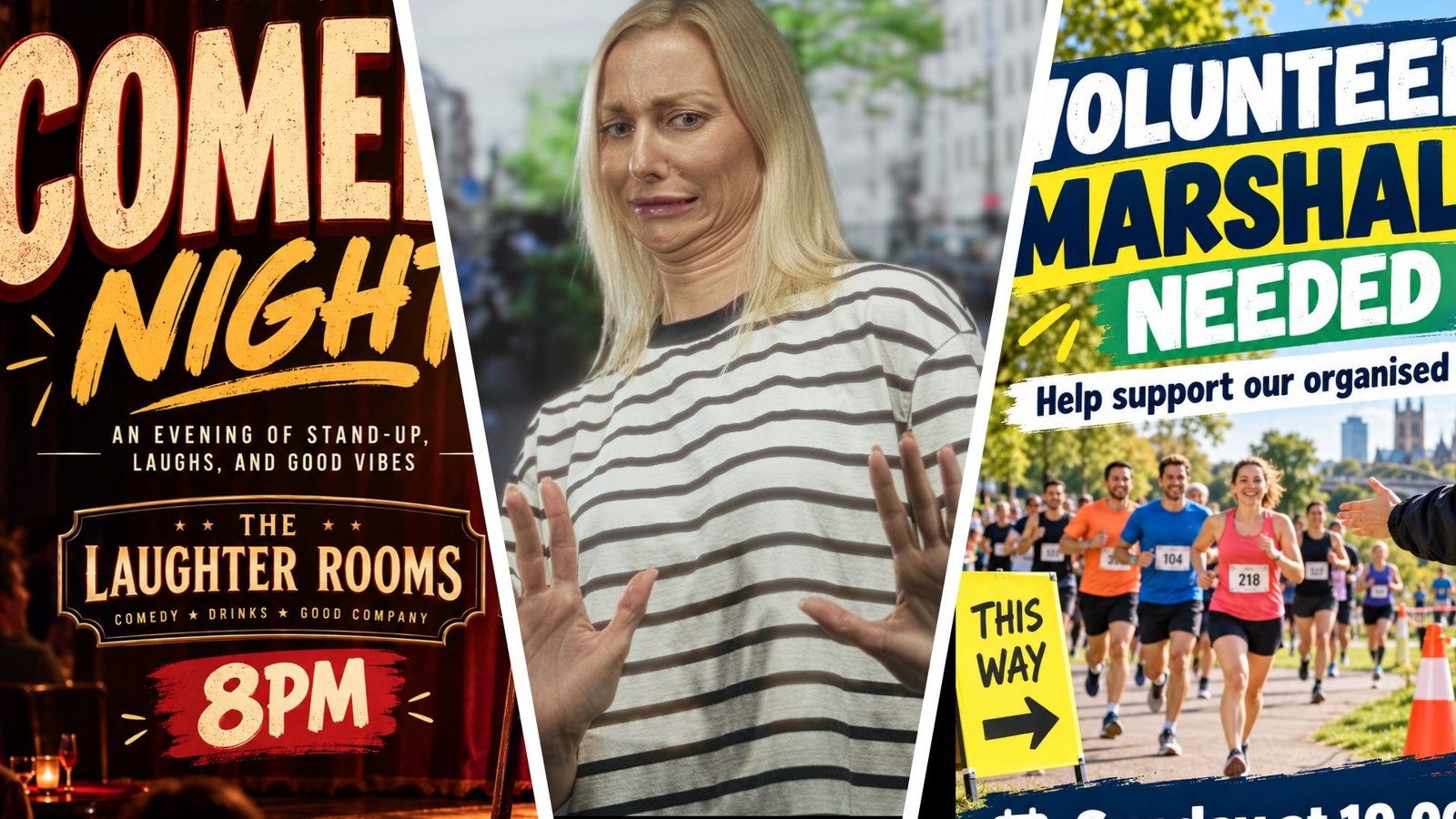
Have you noticed the increase in local event posters made using AI? Suddenly I’m seeing them everywhere. They’re easy to identify because they all look similar, and generic. ChatGPT seems to love marker-felt-style fonts for headings, while the main image invariably has that unmistakable AI-slop look.
Perhaps the new ChatGPT Images 2.5, with its templates for event posters, is to blame, but to me it’s all a bit sickening, and it genuinely puts me off whatever the event is. I feel the same way when I see AI-generated posters in cafe windows showing food.
I’m not the only one either; AI is seen as an increasing threat by those who work in the creative industries. Scientist and professional cartoonist Maria Boyle, whose cartoons appear in New Scientist magazine and who goes by the name twisteddoodles, came to my attention for her cartoon about AI posters:
Getting the ick
I asked Boyle what she thinks of the AI-generated posters appearing everywhere.
“I always feel a sense of disappointment and creatively I get the ick,” she says. “It hurts most when it is places like the library or local schools who are meant to be bastions of creativity. The thing about AI-generated posters looking generic and the same means that essentially all events have the same branding. If AI is used by really good events but also really terrible events, you can’t trust AI art as a brand to equate quality.”
She finds it especially disappointing when businesses use AI to advertise their food with clearly artificial images.
“Recently I went to a coffee shop and all of the posters were AI generated, and the food had an uncanny valley nature to it; but one of the posters advertised a mango granola item I like to get. But because the person making the poster couldn’t get the AI to make the food item look like what they served, they had to change what they served to look like the AI image. So now it is actually bigger and uses more ingredients.”
It’s a funny example, but it also gets at something more serious: what happens when the marketing stops reflecting the actual business?
Because the person making the poster couldn’t get the AI to make the food item look like what they served, they had to change what they served to look like the AI image
Recent research from YouGov found that 78% of Britons would be less trusting of a brand that used AI-generated actors in its advertising, highlighting the potential risks for businesses that rely too heavily on artificial intelligence in consumer-facing campaigns.
Stephen Brookes, founder of UK-based creative agency NPK Media, warns that a purely AI-driven approach to marketing could damage customer trust, one of the most valuable assets a business can have.
“If every advert and social media post starts to look and sound the same because it has been generated using the same tool, businesses risk losing the personality that makes them stand out,” he says.
To Brookes, it’s not just about saving money in the short term, “A business might save money by generating an advert in a matter of minutes, but if that advert feels generic, artificial or disconnected from the reality of the business, the long-term cost could be much greater,” he adds.
“The best marketing doesn’t just fill a content calendar. It communicates something real about the people, products and values behind a business.”
The mysterious talent fairy
I’m always struck by how a lot of people seem completely blind to the distinctive look of AI art, or don’t see any problem with using it at all. Maria Boyle has noticed the same thing — and suggests it points to a deeper feeling of entitlement:
“Some people feel they should be allowed to use AI because of the perception that talent and artistic skill is something innate, and that if you aren’t born with it you should have an entitlement to it and technology can give you that,” she says. “They believe that they aren’t stealing from artists, they’re simply giving themselves something that they were given by fate. But if you ask most artists, what they do has taken years of work and training to achieve and was not something gifted by the mysterious talent fairy.”
Of course, ugly posters are only the visible end of a much bigger issue. A few years ago, much of the debate around generative AI centered on whether companies should be allowed to train models on artists’ work without permission or payment. That debate hasn’t disappeared, but it feels much less prominent today.
“At this stage the models have been trained, they have access to the internet and are still training,” Boyle adds. “Now I don’t think the fight is with AI, the fight is with companies and individuals to see how much they value creative talent.
“That fight is people saying ‘This is made with AI, I don’t like it’ because if AI creation becomes everyone’s ick, not just mine, then that branding will be so damaged they will have to come back to us. Come back to me. I like money and I write really good copy.”
This articles is written by : Fady Askharoun Samy Askharoun
All Rights Reserved to Amznusa www.amznusa.com
Why Amznusa?
AMZNUSA is a dynamic website that focuses on three primary categories: Technology, e-commerce and cryptocurrency news. It provides users with the latest updates and insights into online retail trends and the rapidly evolving world of digital currencies, helping visitors stay informed about both markets.
