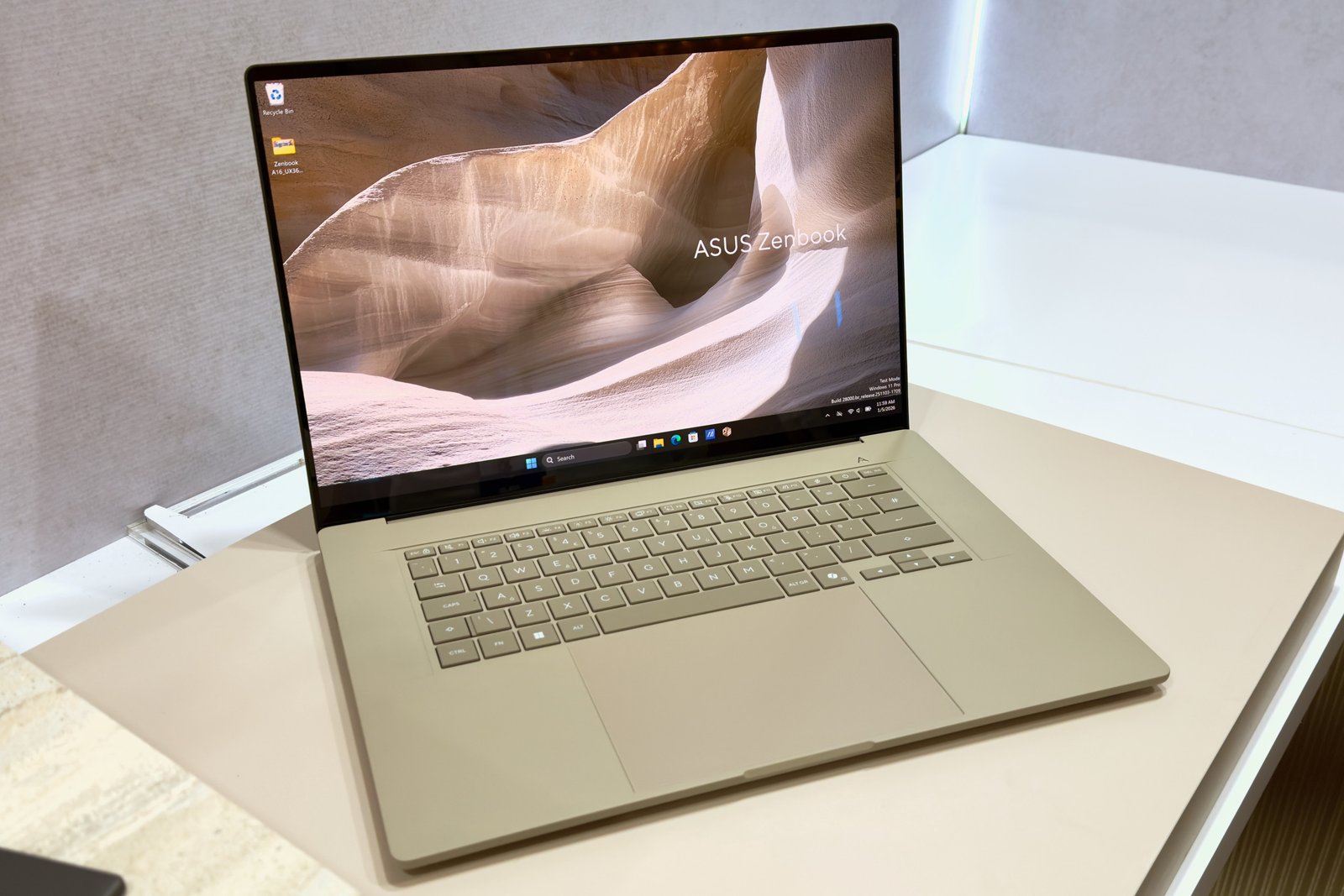
On paper, the Asus Zenbook A16 laptop is eye-popping. Inside it is a new Qualcomm Snapdragon X2 Elite chip and an incredible 48 GB of RAM, all for hundreds less than competing laptops. Tech reviewers responded with glowing reviews, some awarding up to five stars based on the laptop’s performance and price.
A day later, Asus raised the price by $100, from $1,599 to $1,699 at Best Buy. What?! Call it a “bait and ship.”
I haven’t tested the Asus Zenbook A16 yet (still waiting for mine to arrive!), but whenever I evaluate a laptop, I do so from the premise that price and productivity go hand-in-hand. We all want the most value for the money, and Asus appeared to have undercut one of the fundamental principles of tech reviews: that the price a tech journalist references in a review is the price consumers will expect to find at purchase.
So what happened? We asked Asus for an explanation, and it appears to be the fault of Best Buy.
“We were notified by Best Buy after review embargo lifted, and our assets have already been distributed, that an error was made on their end regarding pricing for the new Zenbook A series and other Zenbook launches,” an Asus representative said in a statement.
“To clarify how the retail relationship works: Best Buy determines pricing on their exclusive configurations,” the Asus representative added. “The pricing reflected in our press materials was based on information shared with us prior to launch. Once we were notified of the change, we worked to update reviewers with devices on hand and press as quickly as possible. We know that pricing is a critical part of your evaluation and are very sorry for the poor timing of this update.”
This isn’t an isolated case, though. Hardware Canucks noted that Asus increased the prices of a number of related laptops, too, with the Zenbook S16’s price unexpectedly climbing by $300 to $1,900, and the Zenbook 14 increasing from $1,000 to $1,350.

Best Buy
“This is BAD for our Snapdragon X2E conclusion. Best Buy & Asus issued the wrong prices,” the site concluded, implying that the price hikes were an error.
Asus confirmed the changes. The correct prices are as follows, according to Asus:
- ASUS Zenbook A16: $1,699.99 (previously listed at $1,599.99)
- ASUS Zenbook A14: $1,349.99 (previously listed at $1,149.99)
- ASUS Zenbook S16: $1,899.99 (previously listed as $1,599.99)
- ASUS Zenbook S14: $1,999.99 (previously listed as $1,899.99)
- ASUS Zenbook 14: $1,349.99 (previously listed as $999.99)
Five stars on paper
You probably don’t have to puzzle over why the Zenbook pricing raised eyebrows. The memory! There were concerns that PC makers were going to reduce the amount of memory and storage that they attached to notebooks because of the ongoing shortages, but Asus went in the other direction, delivering a whopping 48GB of soldered-down storage as part of the Zenbook A16. Consider the specifications: a new X2 Elite Extreme processor with 48GB of storage, a 3K screen, and a terabyte of storage, all for $1,599. Lenovo is shipping the Yoga Slim 7x Gen 11 laptop with a similar processor, but with a 1200p screen, 1TB of storage and 32GB of RAM for hundreds more, at $1,839.99.
It’s an incredible difference, and it raised eyebrows internally at PCWorld. I personally verified the Best Buy Zenbook A16 listing on Tuesday, because I was concerned that Asus was sending out an overpowered laptop at Qualcomm’s request to suggest higher performance. It wouldn’t be surprising, however. Intel’s laptop customers included gaming-class 99Wh batteries alongside its Core Ultra 300H (Panther Lake) parts, boosting battery life to well over a day when most of Qualcomm’s customers designed thinner, lighter laptops that still delivered stellar battery life. It’s the sort of games chipmakers sometimes play.
But not laptop makers. For decades, there’s been an implicit assumption that the price we’re quoted for a laptop is the price you’ll pay. It should be obvious, but I’ll say it anyway: price goes hand-in-hand with productivity. The amount of time and effort you need to spend to buy a $75,000 car is far more than what you’d need to put out for a $2,000 laptop. One of the chief metrics we use to evaluate all sorts of tech gear is price. I’ll rule out a dock as a candidate for our best Thunderbolt docks because it’s priced way too high.
PC makers do have a right to raise prices as their costs increase — Framework, for example, has kept consumers updated on how pricing of SSDs, memory, and CPUs force adjustments to their own prices. Its April update claims that CPU prices have actually decreased while SSD prices have gone higher. Lenovo Legion Go prices have increased, too. Still, quoting reviewers one price and consumers another simply smells bad.
Fortunately, I’m still expecting a Zenbook A16 for review by Asus — which we can test using the new, adjusted price.
This story was updated at 1:32 PM PT with additional details from Asus.
This articles is written by : Fady Askharoun Samy Askharoun
All Rights Reserved to Amznusa www.amznusa.com
Why Amznusa?
AMZNUSA is a dynamic website that focuses on three primary categories: Technology, e-commerce and cryptocurrency news. It provides users with the latest updates and insights into online retail trends and the rapidly evolving world of digital currencies, helping visitors stay informed about both markets.
