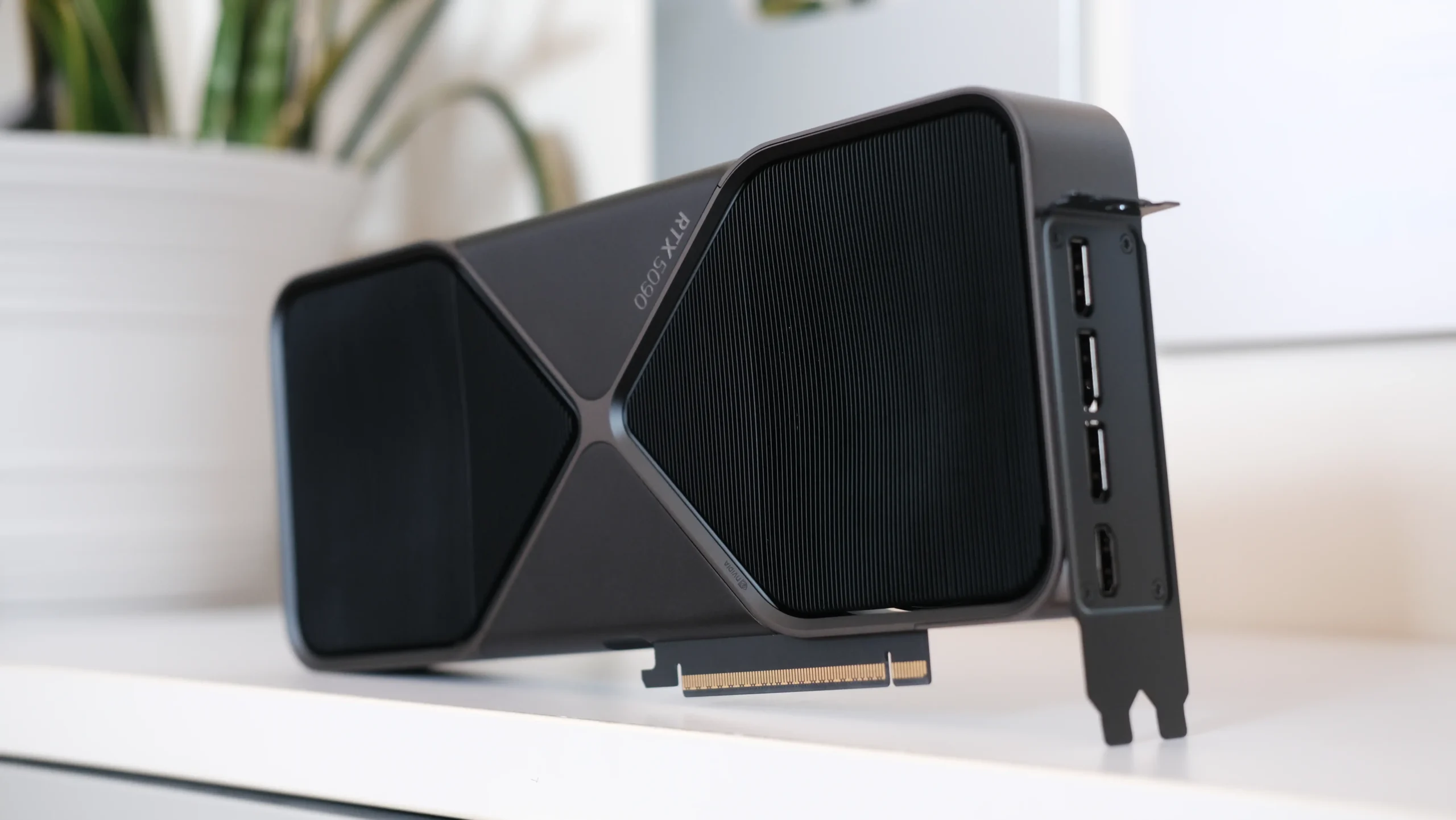
The GeForce RTX 5090 is an absolute monster.
It’s also becoming increasingly difficult to justify for gaming — and ironically, Nvidia’s own DLSS technology is a big reason why.
When the RTX 5090 launched almost two years ago, Nvidia slapped a staggering $1,999 price tag on its new flagship. I called it “the most brutally fast graphics card ever,” because it was (and still is). The RTX 5090 delivered a massive leap in raw performance, paired with a mammoth 32GB of cutting-edge GDDR7 memory and Nvidia’s new Blackwell architecture.
It was overkill incarnate.
Now? Actually buying an RTX 5090 can cost vastly more than its already-staggering sticker price. In September, a brand-new RTX 5090 had climbed to at least $5,000 in North America. Current U.S. price tracking puts the average even higher.
Five. Thousand. Dollars.
And make no mistake: The RTX 5090 is vastly faster than cheaper graphics cards. This isn’t one of those situations where a $549 GeForce RTX 5070 suddenly matches Nvidia’s flagship if you flip on a magic setting, no matter what Nvidia’s marketing material might say.
It doesn’t.
But DLSS is fundamentally changing what all that extra GPU horsepower actually gets you — and that makes the reported discontinuation of the RTX 5090 (Nvidia did not respond to a request for comment) much less catastrophic for gamers.
Nvidia’s $549 GPU can make Cyberpunk look like it’s running at 240fps
The GeForce RTX 5070 was a disappointment when it launched, and part of that was because of how Nvidia marketed it at the time.
Nvidia famously claimed the $549 card could deliver “RTX 4090 performance” thanks to DLSS 4 and Multi Frame Generation, but in traditional rendering, the RTX 5070 barely moved the needle over its predecessor. It was essentially an RTX 4070 Super with newer technology strapped onto it.
That matters. Raw rendering performance is still the foundation everything else rests upon.
But Nvidia’s software has kept evolving since then, and what it can do with that relatively modest hardware is becoming increasingly wild.
In recent hands-on testing by Tom’s Hardware, a $549 GeForce RTX 5070 was able to make fully path-traced Cyberpunk 2077 look like a 240fps experience at 4K using DLSS 4.5 Ultra Performance and Nvidia’s new 6X Multi Frame Generation — a result I’ve experienced myself as well, but I didn’t document it.
Read that sentence again.
A GeForce RTX 5070. Path tracing. 4K. 240fps. It’s absurd!
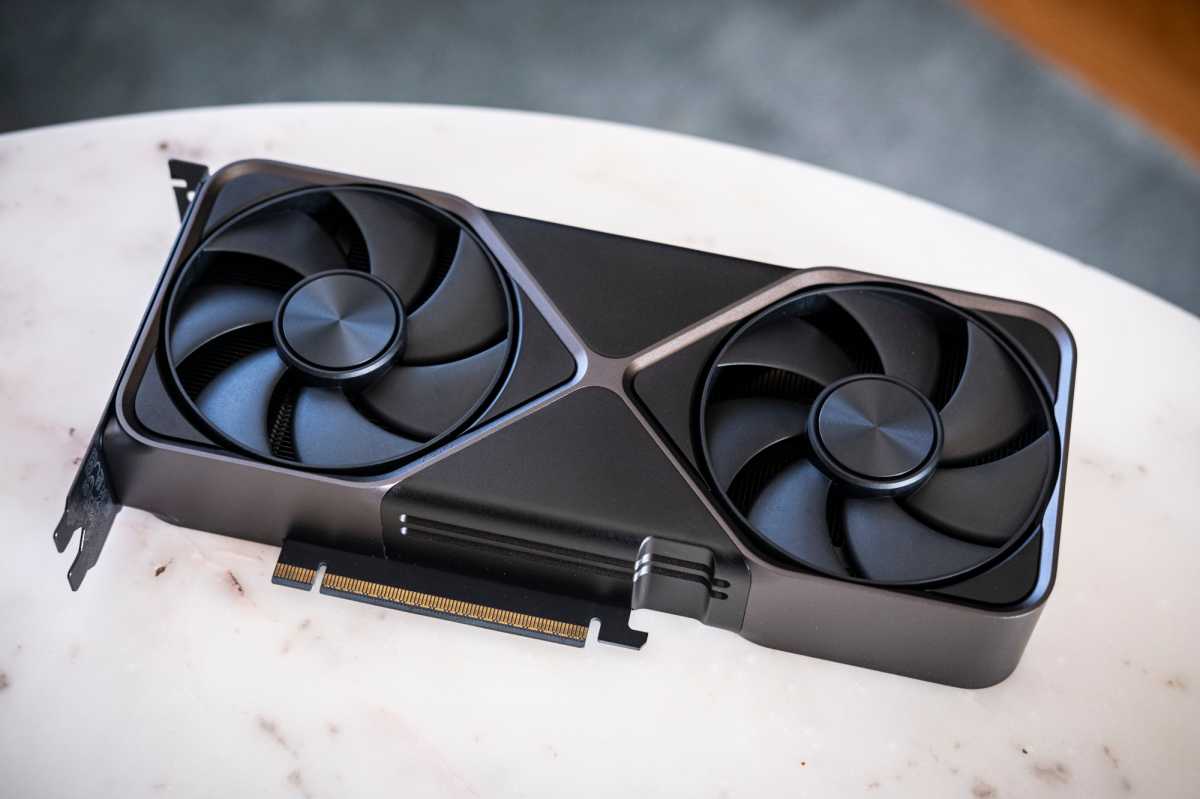
The RTX 5070 is physically much smaller than the RTX 5090 despite sharing the same design language. That’s because it’s a lot weaker in native rendering!
Adam Patrick Murray / Foundry
The RTX 5070 absolutely cannot render fully path-traced Cyberpunk at anything approaching 240 frames per second. Instead, Nvidia is attacking the problem from several directions at once.
DLSS Super Resolution renders the game internally at a lower resolution, then uses AI to reconstruct the final image at your monitor’s resolution. Ray Reconstruction replaces traditional hand-tuned denoisers with an AI model. Multi Frame Generation inserts AI-generated frames between traditionally rendered ones.
And Nvidia’s newer Dynamic Multi Frame Generation technology can automatically increase or decrease the number of generated frames on the fly, attempting to keep a high-refresh-rate monitor fed.
The result can look spectacular.
And that distinction — looking spectacular — matters.
240fps isn’t really 240fps
The RTX 5070 Cyberpunk test relied on DLSS Ultra Performance mode and aggressive 6X frame generation to target 240fps. That’s important. Ultra Performance renders at a dramatically lower internal resolution before reconstructing the image, so this isn’t equivalent to running Cyberpunk natively at 4K.
Nor does a displayed 240fps mean the game suddenly responds like a game being rendered natively at 240fps.
Tom’s Hardware measured 52.6 milliseconds of PC latency with 6X MFG enabled, versus 35ms with frame generation disabled. Pushing from 4X to 6X MFG barely affected latency — 53.2ms versus 52.6ms — even as more generated frames were pumped out due to the way MFG works.
The underlying game is still running much slower. Generated frames don’t respond independently to your inputs. You’re looking at three increasingly separate things: how fast the GPU actually renders the game, how responsive the game feels to your inputs, and how smooth the final output looks on your monitor. (Though Nvidia’s frame-pacing “flip meter” hardware can sometimes make games feel smoother than native rendering, as I’ve experienced firsthand in Star Wars Outlaws.)
DLSS can now push that last number far beyond the first.
That distinction is critical in competitive games, where responsiveness matters far more than eye candy. I wouldn’t want to play Counter-Strike 2 or Marvel Rivals at a low native frame rate hidden beneath a mountain of generated frames.
But Cyberpunk 2077 isn’t Counter-Strike.
What are you actually buying with an RTX 5090?
For decades, buying the fastest GPU available was the straightforward way to get the smoothest possible gaming experience.
Want higher resolution? More ray tracing? Higher refresh rates? Throw more GPU at the problem.
But DLSS is breaking the direct relationship between brute-force rendering power and the visual experience you see on your monitor. Your monitor can now become the limit for visual smoothness long before your GPU stops mattering for responsiveness.
If a $549 graphics card can already keep a 4K 240Hz display visually saturated with frames in a brutally demanding path-traced game, what exactly does spending several thousand dollars more on an RTX 5090 buy you as a gamer?
Plenty.
The RTX 5090 gives you vastly more raw rendering horsepower. It lets you start from a much higher base frame rate before frame generation kicks in. That means lower latency, fewer reconstruction compromises, and more flexibility to crank image-quality settings without resorting to aggressive modes like DLSS Ultra Performance.
Same goes for the RTX 5090’s enormous 32GB pool of GDDR7 memory and tremendous memory bandwidth. For local AI workloads, professional applications, rendering, content creation, and other compute-heavy tasks, Nvidia’s RTX 5090 is an entirely different beast from the 5070.
But do gamers still need anything remotely so powerful to achieve the visual experience they’re chasing?
Increasingly, the answer is no.
Nvidia is disrupting its own flagship
That’s what makes Nvidia’s advances in DLSS so fascinating.
The company spent decades convincing enthusiasts that more rendering horsepower was the path to better gaming. Bigger GPU. More CUDA cores. More memory bandwidth. More frames.
Now Nvidia is getting extraordinarily good at using AI to sidestep brute-force rendering altogether. And the company deserves enormous credit for it.
Dynamic MFG pushes that idea even further. The GPU doesn’t necessarily need to brute-force every single frame your monitor displays anymore. Nvidia can dynamically adjust how aggressively it generates frames to target the display you’re actually using.
This stuff isn’t marketing fluff. It works, albeit imperfectly at times.
But technological success creates an awkward problem at the extreme high end: The better DLSS becomes at extracting spectacular visual results from modest hardware, the harder it becomes to explain why a gamer should spend several thousand dollars on the biggest GPU Nvidia can build.
Especially when that GPU now costs enough to buy an entire monster gaming PC several times over. ($5,000, seriously?!)
The RTX 5090 is still king. That’s not the point
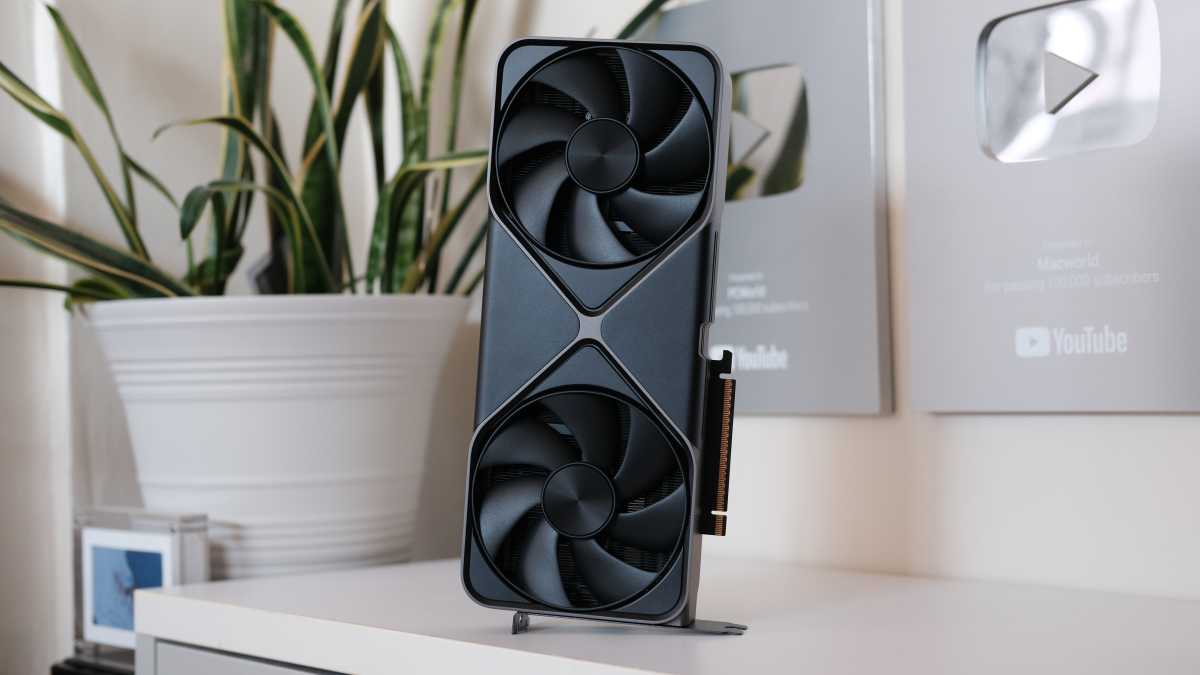
Nvidia’s RTX 5090 Founders Edition.
Adam Patrick Murray / Foundry
None of this makes the RTX 5090 slow. It absolutely freakin’ isn’t.
The RTX 5090 remains the fastest gaming GPU on the planet. If you want maximum native rendering performance, minimum latency, giant pools of VRAM, or serious compute horsepower, nothing about DLSS makes those advantages disappear.
There’s a meaningful difference between a game genuinely rendering at a high frame rate and one displaying a high frame rate after AI-generated frames are inserted. But visual smoothness is no longer a clean proxy for rendering horsepower.
That’s the change DLSS 4 accelerated. It’s a momentous one.
And for visually demanding single-player games — exactly the sort of experiences that once justified buying a ludicrous flagship graphics card — Nvidia’s AI-powered DLSS technologies are increasingly capable of producing the visual experience people actually want without requiring anything close to flagship-class hardware.
That’s why I’d have an increasingly difficult time telling somebody to spend $5,000 on an RTX 5090 purely for gaming.
Almost two years ago, when Nvidia unveiled the RTX 5090 and the rest of the Blackwell generation, I said the graphics cards themselves weren’t the most exciting part.
I called DLSS 4 the real game changer.
I’d make the same call today. As for the RTX 5090? It was never truly meant for gamers anyway. As Ivan Drago famously said in Rocky IV: If it dies, it dies.
This articles is written by : Fady Askharoun Samy Askharoun
All Rights Reserved to Amznusa www.amznusa.com
Why Amznusa?
AMZNUSA is a dynamic website that focuses on three primary categories: Technology, e-commerce and cryptocurrency news. It provides users with the latest updates and insights into online retail trends and the rapidly evolving world of digital currencies, helping visitors stay informed about both markets.
