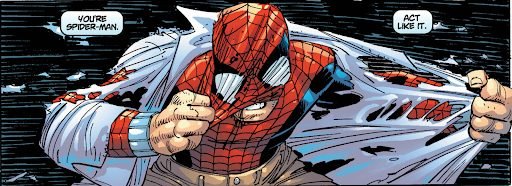
Being a Spider-Man fan is interesting. It’s a fandom that’s been gifted with a near limitless supply of stories and maximum job security. There are better chances that the NBA’s popularity falls off before Spidey’s popularity wanes. But it is a fandom that’s hardly bereft of frustrations. And after the first trailer for the upcoming Spider-Man: Brand New Day, those frustrations reverberate in a way that makes you feel remarkably indifferent to the whole thing.
The movie doesn’t look like a mess or anything in a Madame Web way. And there’s no reason to believe it will be. So what the heck am I complaining about, then? Well, it’s not that the character has been in bad stories lately, per se, but rather exceptionally fine ones. That sentiment applies for movies, video games, and especially comic books. There’s just something missing.

Dan Kemp
Spider-Man, as a character, has near limitless potential for stories given his everyman ethos and relatability. But back in April 2001, J. Michael Straczynski, a writer and a man who one can only assume was sent by heaven itself, showed exactly the kind of ceiling the character had by doing something many modern Spider-Man stories seemingly refuse to allow: Peter Parker growing up.
Straczynski’s run on the character began in earnest back with The Amazing Spider-Man #30 and lasted all the way until 2007. It remains a classic to this day, mostly because it allowed the character to evolve. Doing so involved some major decisions, with one of the headliners of his run being the remarriage of Peter and Mary Jane Watson who had been separated for…reasons I don’t have time to explain. (I also don’t feel like doing that, because explaining dumb things makes you more dumb according to Science.) They’re an iconic fictional couple for a reason. Mary Jane and Peter play off each other’s lives perfectly, they’re relatable, and endlessly adorable.

Dan Kemp
There’s a sense for people that, somehow, having some semblance of your life being put together makes your story less engaging. Being married would make Peter’s story less exciting because famously being happily in love is boring. As we’ve seen from Clark Kent and Louis Lane being canonically married for 600 years, it’s impossible to craft stories around married superheroes.
But it’s not just that which sets the table for this more grown up Spider-Man. Yes, the relationship is handled brilliantly by Straczynski—especially since it has the adage of the re-connection between Peter and MJ that’s given plenty of time, too —and written with a warmth that would make Nora Ephron proud. But we also learn what Peter’s new profession is. Professor Parker is another aspect of Straczynski’s run that’s equally as important, if not more. It allows the character to truly evolve past his days of simply making ends meet. Peter’s new gig as the science teacher at his old school gives him a new purpose.
Spider-Man has always been about helping people, especially the Little Guy. So, there’s no better next step for the nerdy science aficionado than to literally guide along the next generation of individuals that are literally little guys: students. Even Peter can see the writing on the wall. The modern world isn’t one that’s been especially conducive for our children to thrive in, noting in Amazing Spider-Man #32 that “So much of their innocence is gone. The sense of wonder is gone. Their road is harder.” It’s a sentiment that, unfortunately, grows truer by the day.

Dan Kemp
And Straczynski doesn’t have Peter be a teacher just to gobble up time before he’s donning the costume and giving the ole’ “Bam, Smack, Kapow” to whatever dangerously fantastical foe is putting the city in danger. Instead, it’s the focal point of what he’s trying to do. Many of the story arcs during Straczynski’s run focus on them, and hence comes much of the depth that many modern Spider-Man stories lack. They’re grounded in a completely different way.
There’s Jennifer, a student with oodles of potential that’s being squandered by being forced to live on the street and worrying about her drug-addled older brother. It cedes room for Peter to, as part of his classic attribute of finding ways to blame himself, question why he hasn’t noticed all the people who are going through such horrible situations. He didn’t see this despite quite literally swinging by these places throughout the city time and time again. Instead, he was too busy dealing with crazy supervillains to remember the regular trials and tribulations that society is plagued with.
There’s also someone like Melissa, who has all the smarts in the world. On top of her and her single mom having to deal with a scummy landlord (I realize “scummy” and “landlord” might be an oxymoron for some), she has to live without her beloved older brother, whom Spider-Man threw in jail. It gives Peter some much needed introspection, a fresh critique of superheroes as a general principle. This situation examines how heroes can sometimes misdirect their ire towards lower levels of crime, rather than the systems that elicit such behaviour in the first place.
It’s not that all modern Spider-Man stories are bereft of serious moments. But oftentimes, when they do have them, it feels like their idea of serious is a “Just Make Him Miserable and Depressed” easy button. And it doesn’t feel like they’re trying to say anything. Straczynski didn’t have interest in doing that. In one of the first subplots told featuring a school shooting, it feels like a tone-setter for the entire series. It says “Yeah, we’re here, and we’re going for it.”
Straczynski’s run acts as an antidote, of sorts, to the far less interesting “Haha! I conquer! I destory! I’m bad guy!” sort of narrative that feels more like generating hype moments and fodder for power-scaling conversations than telling a good, character-driven story. For a good portion of its run, it is almost allergic to the idea of having blockbuster-esque setpieces. He’s the friendly neighborhood Spider-Man after all, so why not act like it?
Sometimes there will be a slice-of-life storyline, with nary a single textbox, showing how Mary Jane goes about her day as a fulltime model. Or, there’s Aunt May writing complaints to the Daily Bugle about their one-sided Spider-Man coverage. Other times, Spider-Man will just…meet a simple tailor, who helps out both the good and bad guys. This level of groundedness makes the world feel truly lived in. You’re part of the neighborhood, meeting all sorts of people with their own stories.
But all this isn’t to say that Straczynski’s Spider-Man run is completely bereft of any goofiness. In fact, it’s often even more so than most you’ll come across in any medium. There’s a real strong voice for Peter here that’s both witty and down-to-Earth in the best way. It’s unfairly funny, really, because you think of how often modern superheroes rely so heavily upon the “Wow, isn’t it CRAZY what just happened?” type of self-referential humor.

Dan Kemp
He’ll interact with random New Yorkers, powerful political figures, and even literal gods like Loki, all with the same familiar cadence that a friendly neighbor would. It’s a comforting style of dialogue that Straczynski utilizes that’s never overbearing unless it absolutely has to be, saving expositional dumps for your Avengers-type arcs instead. It’s mind-boggling how talented of a writer someone can be.
The word “unfair” might be, in some ways, the word that perfectly encapsulates the J. Michael Straczynski Spider-Man run. There’s one particular story that feels quite analogous to the frustration with the character I mentioned early on. Ezekiel, a mysterious, elderly businessman who happens to have the same powers as Peter, isn’t quite a bad guy, but rather someone who never bothered using his powers for anything other than himself. He turned away when people were in danger, enriched himself, and took the safe route.
That’s what many modern Spider-Man stories are: safe. With rare exception (Spider-Verse, we love you, but for different reasons), Peter Parker isn’t given the chance to be more. I’m worried that Brand New Day might play it too safe. Whether you want to blame writing or the ever-evolving algorithmic and people-pleasing decision making determining how these giant properties go forward, or Disney, it’s all unfair.
It’s unfair because you know it can be cleverer and funnier. It’s unfair because you know it can be more genuinely romantic. It’s unfair because you know it can have so much more to say than fan service and spectacle. It’s unfair because you know it can be so much more. It’s unfair to know J. Michael Straczynski’s run on the Amazing Spider-Man is out there, and everything else seems to fall just short of it.
The post J. Michael Straczynski’s THE AMAZING SPIDER-MAN Run Remains Untouchable appeared first on Nerdist.
This articles is written by : Fady Askharoun Samy Askharoun
All Rights Reserved to Amznusa www.amznusa.com
Why Amznusa?
AMZNUSA is a dynamic website that focuses on three primary categories: Technology, e-commerce and cryptocurrency news. It provides users with the latest updates and insights into online retail trends and the rapidly evolving world of digital currencies, helping visitors stay informed about both markets.

