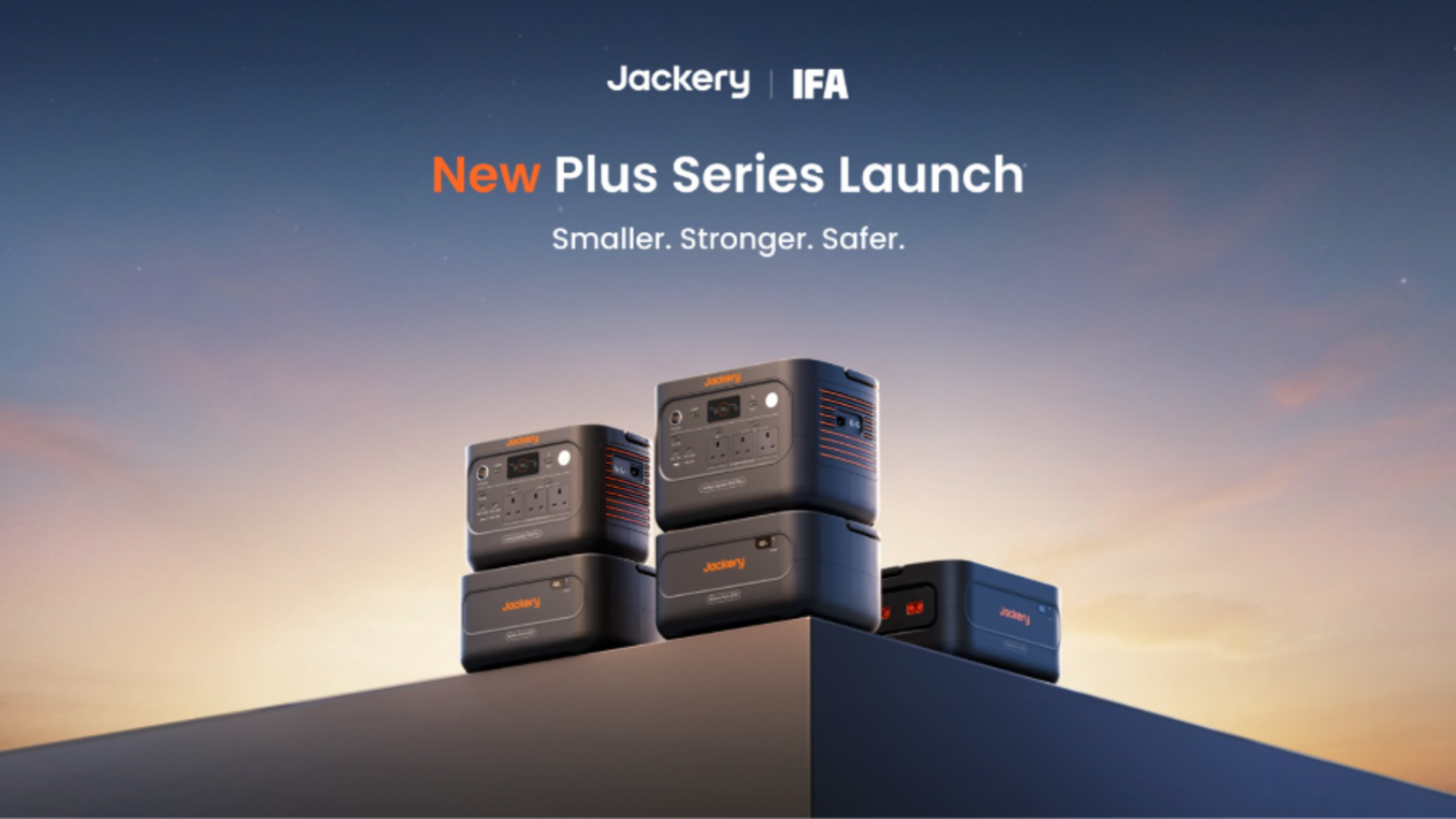
- Jackery cuts power station’s size without reducing the stated battery capacities
- The Explorer 2000 Plus v2 loses 33% weight while retaining 2,048Wh capacity
- CTB 2.0 lets Jackery integrate battery cells directly into the enclosure structure
Jackery has applied an automotive battery packaging technique to two new portable power stations, reducing its physical footprint without cutting the stated capacities.
The Explorer 1000 Plus v2 and Explorer 2000 Plus v2 use a Cell-to-Body architecture that integrates battery components into their structural enclosures.
The company said this approach cuts the Explorer 2000 Plus v2’s size by 60% and its weight by 33%, and reduces the Explorer 1000 Plus v2’s size by 44% while its weight plunges by 26%, compared with their predecessors.
CTB architecture cuts size while retaining large battery capacities
Explorer 2000 Plus v2 stores 2,048Wh, weighs 18.8kg and measures 36.6 × 25.5 × 27.2cm, while the Explorer 1000 Plus v2 stores 1,024Wh, weighs 10.8kg and measures 31.35 × 20.1 × 23.35cm.
“People don’t want more power at the cost of bulk — they want power that fits naturally into their lives,” said Brady Sun, Head of Europe at Jackery.
“With the Explorer Plus v2 Series, we’ve drastically reduced size while elevating energy density, intelligence, and safety.”
The company uses CTB 2.0 to integrate cells with the enclosure, reducing unused internal volume that would otherwise require additional structural components.
That approach is similar to battery packaging methods used in electric vehicles, where manufacturers integrate structural elements around battery cells.
According to Jackery, it is the first portable energy storage brand globally to introduce EV-derived CTB construction into this product category.
It also holds US and Japanese invention patents covering its earlier CTB 1.0 implementation, which used welding on both sides.
Both models support expandable storage, allowing the 1,024Wh model to reach 11kWh and the 2,048Wh version to reach 12kWh.
The larger model supplies 2,400W continuously, with temporary output reaching 4,800W, while the smaller unit provides 1,800W continuously.
Large output and fast charging remain part of the package
Both power stations come with AC outlets, two USB-C connections reaching 140W, one USB-A port, and one 12V/10A vehicle socket.
Solar charging reaches 400W on the smaller unit and 800W on its larger counterpart, while AC charging takes 1.25 and 1.5 hours, respectively.
Jackery also specifies emergency charging periods of 50 minutes for the 1000 Plus v2 and 80 minutes for the 2000 Plus v2.
Both models incorporate a 10ms UPS function intended to maintain connected equipment during brief interruptions to household electricity supplies.
Their ceramic-coated LFP cells are rated for 6,000 cycles while retaining 70% capacity, with Jackery claiming service life reaching 30 years.
The systems can operate in temperatures as low as -20°C, while charging remains supported between -10°C and 45°C.
Orders will open across the UK and Europe on October 14 2026 – subscribers can receive 35% discounts on selected accessories, while qualifying station and solar-panel bundles include a 102W GaN charger worth £54.99.

This articles is written by : Fady Askharoun Samy Askharoun
All Rights Reserved to Amznusa www.amznusa.com
Why Amznusa?
AMZNUSA is a dynamic website that focuses on three primary categories: Technology, e-commerce and cryptocurrency news. It provides users with the latest updates and insights into online retail trends and the rapidly evolving world of digital currencies, helping visitors stay informed about both markets.
