

It’s a fact of life when starting a computer, that booting into whatever operating system you use will take a while. Mine takes somewhere around 30 seconds, and yours probably does too. There has always been the promise of something faster just around the corner, but somehow the OS just keeps getting a little bigger. Perhaps the only computer with a disk based operating system I have ever owned which bucked this trend was a Commodore Amiga, and that machine’s booting speed was achieved by keeping most of its OS in a ROM. The subject of today’s Daily Drivers takes the idea of a long boot time and shreds it, leaving an experience more akin to that Amiga of old. It’s called KolibriOS, it’s small enough to run from a floppy disk if you want it to, it’s lightweight, and fast as lightning. It achieves this feat by being written entirely in assembly language, and it exists as a free fork of the earlier MenuetOS which moved to a proprietary licence in its 64 bit version. I downloaded the ISO file, and gave it a spin.
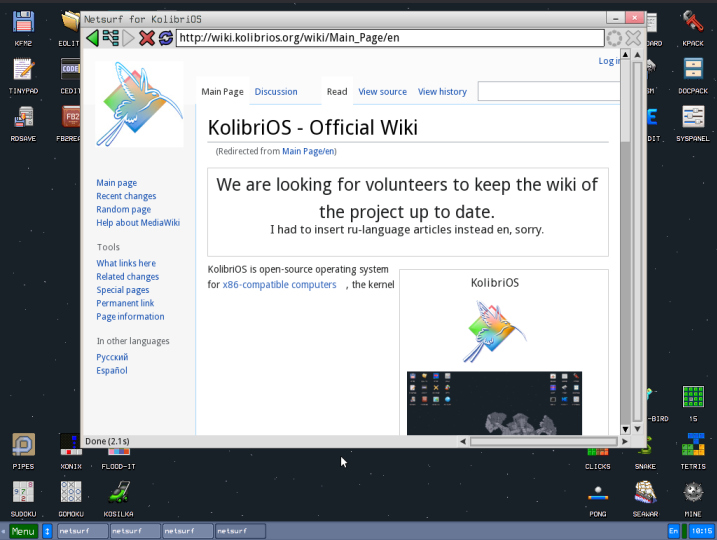
The minimum system requirements for KolibriOS are meagre, 1Mb of disk space, 8Mb of RAM, and a 586-class 32-bit processor. On a 2020s ThinkPad it boots in the proverbial blink of an eye, and drops immediately into a GUI desktop. It has the slightly pixelated look of a 1990s machine, there’s none of the anti-aliasing we’re used to today going on there. Installed software ranges from a set of games, emulators, graphics editors and viewers, internet software including the Webview and Netsurf web browsers, and assembly software development.
The immediate impression is of a mature and useful operating system, without any crashes or blue screens, and with applications that load on a dime. Unfortunately though, despite all the competence I can’t call it a Daily Driver by my definition of being able to write for Hackaday, because the web browser doesn’t support https. Immediately the majority of the modern Internet is off-limits, including this site. This changes the parameters of my review and I can no longer proceed as I normally would, but it doesn’t end it. Something this polished deserves a while to play around.
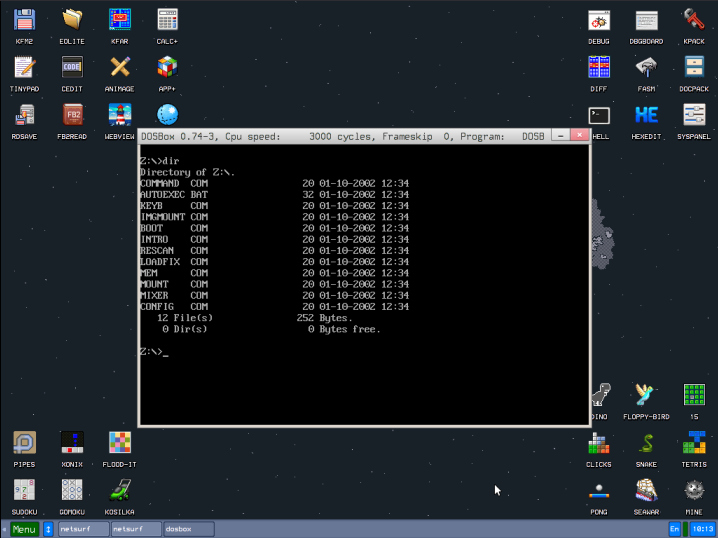
Diving into the command prompt gives a feeling somewhere between a UNIX style OS and DOS, as the commands are UNIX-style but their output feels more DOS-like. Navigating around the disk I’m immediately struck by how small the executables are due to their being written in assembly language. The only exceptions are those applications ported from outside such as Netsurf or DOSBox, which is hardly surprising.
Back in the 1990s there was a single-floppy demo of the QNX operating system that packed the OS, a GUI, and a reasonable web browser for the day. At the time it was mind-blowing to see so much in such a small space, and I am reminded of that QNX demo when I use KolibriOS. This is evidently a useful OS, and I am only sad that it doesn’t support the one thing that would make it useful for my purposes. If you have an older machine I can see it would make a great emulator platform though, and since one of the emulators gives you DOS it’s likely it could also run a lot of useful things from that OS. It will never offer the flexibility on a 32-bit laptop that a Linux distro such as SliTaz can, but on the other hand that low system requirement means it could make a much older 32-bit machine into something useful. If you’ve got some ancient hardware and fancy something new, give it a try!
This articles is written by : Fady Askharoun Samy Askharoun
All Rights Reserved to Amznusa www.amznusa.com
Why Amznusa?
AMZNUSA is a dynamic website that focuses on three primary categories: Technology, e-commerce and cryptocurrency news. It provides users with the latest updates and insights into online retail trends and the rapidly evolving world of digital currencies, helping visitors stay informed about both markets.
