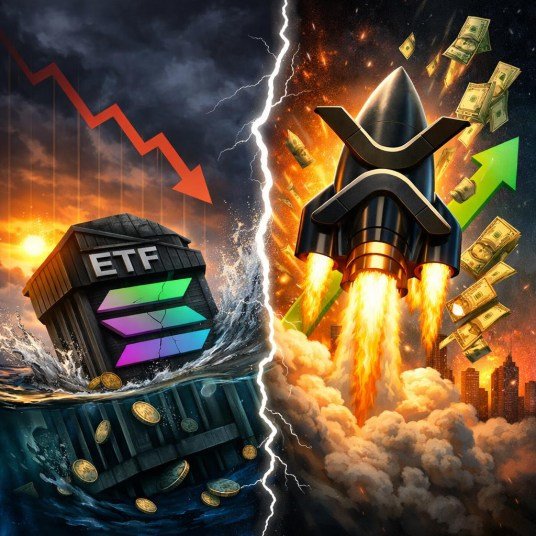
XRP exchange-traded funds (ETFs) have pulled in more money than their Solana ETF counterparts even though SOL has largely outperformed XRP on price during much of the year. The difference, according to market expert Sam Daodu, appears to come down to what’s happening on the regulatory and institutional side.
Different Paths For XRP And Solana ETFs
Daodu highlighted that XRP ETFs have gathered $1.39 billion in cumulative inflows since their November 2025 launch. Solana ETFs, launched in October, have accumulated $1.12 billion over the same overall timeframe.
In other words, despite XRP entering a drawdown from its summer 2025 high and despite SOL’s relative price strength, XRP’s ETF flows have still landed ahead, with the inflow gap persisting at the cumulative level.
The pattern of ETF demand for XRP also looks particularly consistent. Daodu noted that XRP ETFs logged a 13-day streak of positive net flows in early December 2025, a run that came in ahead of Solana’s cumulative inflow total of $618.59 million within those 13 trading days.
Looking at more recent flow data, XRP reported $81.6 million in April inflows alongside a 14-day inflow streak. By the end of April, that put XRP’s year-to-date inflows at roughly $124 million.
Solana’s April inflows were far lower—$38.69 million, which is less than half of XRP’s April figure. Daodu also pointed out that Solana’s monthly inflows fell from $419 million in November 2025 to $38.69 million in April, suggesting a weaker stretch that only appears to be improving now.
That recovery is showing up in May. Solana has posted more than $99 million after 19 trading days, while XRP is close behind with roughly $95 million in the same period.
Even so, the larger story remains that XRP has maintained a steadier inflow profile relative to Solana, and Daodu believes there is a catalyst supporting that steadiness—one that Solana does not have.
Alpenglow Vs CLARITY Act
In Daodu’s view, the structural difference is the CLARITY Act. He argued that this is the “structural difference the price charts don’t show,” because a full Senate vote would help establish a clearer legal framework around issues that matter directly to regulated institutions.
Specifically, Daodu said the bill would create defined rules for XRP custody, collateral treatment, and balance sheet exposure—an “exact compliance checklist” for pension funds and regulated asset managers that need clarity before allocating capital at scale.
Solana, by contrast, is associated with a different kind of catalyst: Alpenglow, a network upgrade aimed at achieving sub-150ms transaction finality. Still, Daodu emphasized that throughput improvements alone don’t unlock the same category of institutional money as regulatory clarity does.
He suggested that the capital attracted by clarity is the type that could help close the gap between XRP’s $1.39 billion in inflows and the $4–8 billion inflow range JPMorgan has projected if the bill passes.
The expert concluded that for XRP to break higher in price, the market likely needs an even larger catalyst—particularly regulatory clarity through the CLARITY Act and stronger institutional participation.

At the time of this writing, XRP traded at $1.37, recording a 3.8% drop on the weekly time frame, while SOL traded at $86, recording even greater losses of 6% in the same period.
Featured image created with OpenArt, chart from TradingView.com
This articles is written by : Fady Askharoun Samy Askharoun
All Rights Reserved to Amznusa www.amznusa.com
Why Amznusa?
AMZNUSA is a dynamic website that focuses on three primary categories: Technology, e-commerce and cryptocurrency news. It provides users with the latest updates and insights into online retail trends and the rapidly evolving world of digital currencies, helping visitors stay informed about both markets.
