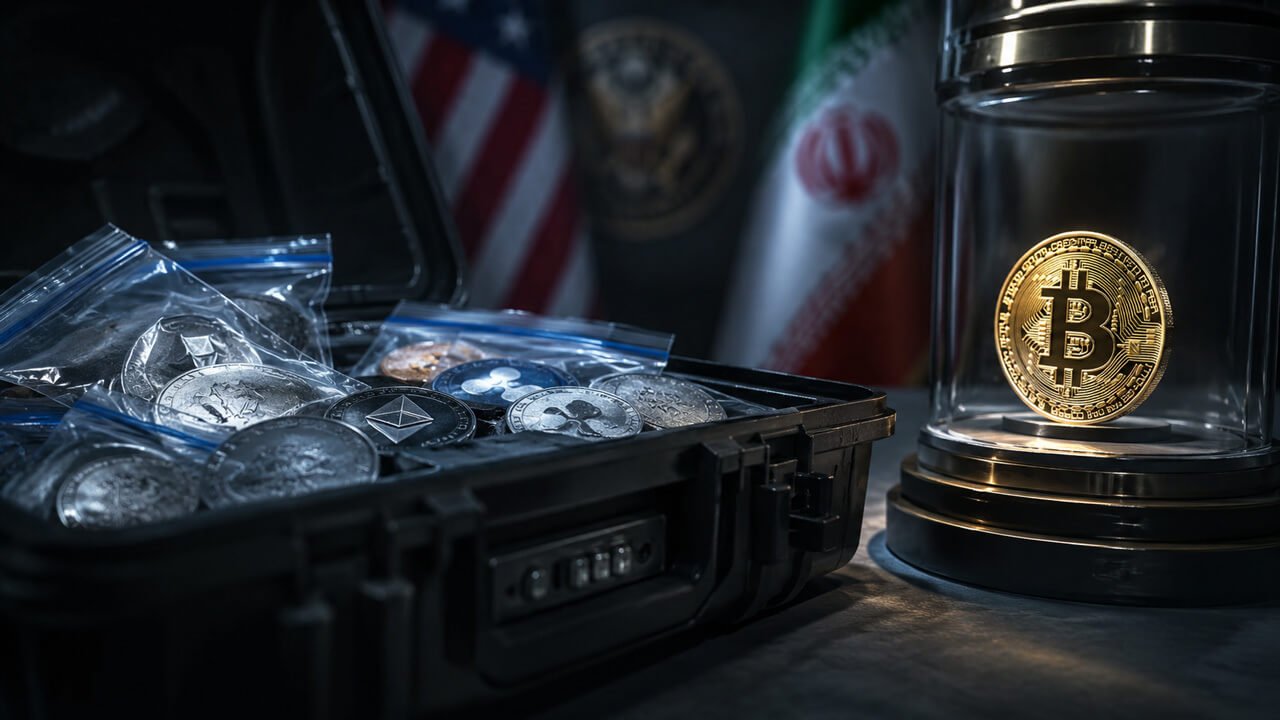
reasury Secretary Scott Bessent said at the Reagan National Economic Forum that the US had seized roughly $1 billion in Iranian crypto assets, turning the Iran crypto seizure into an early test of Trump’s reserve framework
Bessent added the authorities “just outright grabbed the wallets,” with CBS reporting he also described the assets as money stolen from the Iranian people.
Yet Bessent disclosed neither the asset types nor the wallets involved, and that lack of information is exactly what determines whether any of this money ever reaches President Donald Trump’s Strategic Bitcoin Reserve.
Trump’s 2025 executive order created two separate buckets for government-held digital assets. The Strategic Bitcoin Reserve holds BTC that has been finally forfeited through criminal or civil proceedings, or collected through civil penalties, and the order states that government BTC deposited into it shall not be sold.
That split makes the Iran crypto seizure a classification test: Bitcoin can move toward the Strategic Bitcoin Reserve only after final forfeiture, while non-BTC tokens belong in the US Digital Asset Stockpile.
The US Digital Asset Stockpile is a separate container for non-BTC digital assets owned by the Treasury after final forfeiture.
If any Iranian-linked Bitcoin assets reach final forfeiture, they could enter the Reserve, but if they are stablecoins or other tokens, the Stockpile is the more likely destination. There is still a possibility that the assets are frozen, in which case the US may not own them yet.
| Placement | Visual | Format | Purpose |
|---|---|---|---|
| Visual 1 — after the section “What ‘grabbed’ actually means” | The legal path from frozen crypto to reserve asset | Flowchart / process table | Clarifies the most important nuance: “grabbed” does not automatically mean U.S.-owned or reserve-eligible. |
| Visual 2 — after “The scale behind the claim” | How Bessent’s $1B claim compares with known Iran crypto activity | Bar chart | Shows that $1B is plausible in scale, while still partly opaque. |
| Visual 3 — near the end, before the final two paragraphs | Where seized Iranian crypto could end up | Scenario table | Gives the article a forward-looking policy framework. |
What “grabbed” actually means
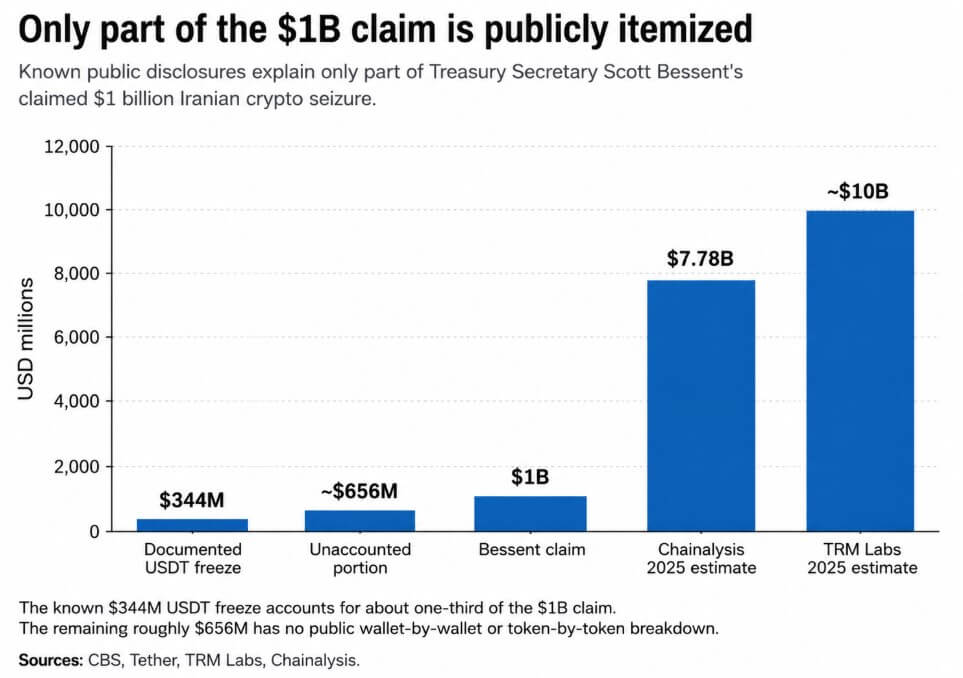
In April, reports pointed out that the Treasury sanctioned multiple Iran-linked wallets, and Tether confirmed it had frozen $344 million in USDT across two addresses after coordination with US authorities.
TRM Labs identified the same wallets as tied to the Central Bank of Iran and linked to the IRGC-Qods Force and Hezbollah. The remaining roughly $656 million lacks public wallet-by-wallet or token-by-token accounting.
The gap between “grabbed” and legal ownership runs through several distinct states. Under OFAC rules, blocked property is frozen, but the US does not necessarily own it.
For stablecoins such as USDT, an issuer can freeze tokens at specific addresses after government coordination, which is a sanctions hold rather than a seizure in the criminal-law sense.
A law-enforcement seizure means the government has asserted custody, but title still depends on the outcome of forfeiture proceedings.
Final forfeiture is the threshold the reserve order requires, since only once that process completes, and only if the assets are not owed to victims, used in law-enforcement operations, shared with state and local agencies, or released under other statutory obligations, do the assets become eligible for the Reserve or Stockpile. Bessent’s language leaves every one of those states open.
At the current BTC price of roughly $73,000, a fully Bitcoin-denominated $1 billion seizure would equal about 13,632 BTC.
In 2025, the US government was expected to retain an estimated 200,000 BTC already seized through criminal and civil proceedings under the reserve framework, a hypothetical 13,632 BTC addition would represent about 6.8% of that base.
The public record shows a documented stablecoin freeze and a gap of roughly $656 million with no wallet-by-wallet or token-by-token accounting, and neither component has a confirmed final forfeiture on record.
The USDT freeze remains the only publicly itemized component of the $1 billion claim.
The scale behind the claim
Iran’s crypto footprint makes a $1 billion seizure plausible in terms of scale, even if the composition stays opaque.
Chainalysis estimated that Iran’s crypto ecosystem reached $7.78 billion in activity in 2025 and said IRGC-linked flows accounted for roughly 50% of Iran’s total crypto ecosystem in the fourth quarter of 2025.
TRM Labs estimated roughly $10 billion in total Iranian crypto activity in 2025, and an investigation into Nobitex, Iran’s largest crypto exchange, found it had processed transactions totaling tens of millions to hundreds of millions of dollars linked to sanctioned groups, including Iran’s central bank and the IRGC.
Nobitex claims to have 11 million users and to handle an estimated 70% of Iran’s domestic crypto transactions. Against that backdrop, a $1 billion figure across multiple enforcement actions and issuer-level freezes is consistent with the known scale of Iran’s crypto activity, even if the exact asset mix and legal status remain unverified.
The asset mix behind the Iran crypto seizure
If a meaningful portion of the $1 billion is in Bitcoin, the Treasury holds those assets, and they clear final forfeiture without triggering victim restitution or law-enforcement carve-outs, they would join a Reserve that the executive order prohibits from selling.
Foreign-adversary enforcement becomes sovereign accumulation, and crypto that Iran allegedly used to bypass US financial pressure converts into a permanent line on America’s digital asset balance sheet.
The clearest documented component of $344 million is USDT, a stablecoin that Tether froze at the address level after government coordination. If the remaining $656 million follows a similar pattern, the $1 billion is predominantly a stablecoin enforcement story.
Frozen USDT stays frozen USDT, and finally forfeited non-BTC assets flow into the Digital Asset Stockpile, where the Treasury Secretary determines stewardship strategy.
A full accounting of the wallets could change the headline from sovereign accumulation to stablecoin compliance infrastructure, two very different policy outcomes that Bessent’s language does not yet resolve.
The executive order also allows the government to return assets to identifiable victims, deploy them in law-enforcement operations, share proceeds with state and local agencies, or release them under statutory requirements.
Each is a gate between “seized” and “reserve asset,” and any of them can be applied before or after final forfeiture.
The architecture Trump’s reserve order created turns every future seizure of a foreign adversary into a sovereign asset-management decision.
| Scenario | Asset mix | Legal status | Likely destination | Article implication |
|---|---|---|---|---|
| Bitcoin reserve case | Meaningful BTC portion | Finally forfeited | Strategic Bitcoin Reserve | Foreign-adversary enforcement becomes sovereign BTC accumulation |
| Stablecoin enforcement case | Mostly USDT or other stablecoins | Frozen or issuer-blocked | No reserve transfer yet | Story is about sanctions reach and stablecoin compliance |
| Digital Asset Stockpile case | ETH, TRX, USDT, or other non-BTC tokens | Finally forfeited | U.S. Digital Asset Stockpile | Crypto becomes government-held, but not part of the Bitcoin Reserve |
| Legal carve-out case | Any asset type | Victim, court, law-enforcement, or statutory claim applies | Returned, shared, sold, or otherwise disposed | Reserve angle weakens; due process controls outcome |
Every enforcement action against Iran, North Korea, or any sanctioned entity now arrives with secondary classification questions of what asset, what legal state, and which bucket.
The Iran crypto seizure becomes a Bitcoin Reserve candidate only if the assets are BTC, the government obtains title through final forfeiture, and no restitution, court, or statutory claim takes priority.
Crypto that adversaries used to circumvent US financial power now risks becoming part of it, provided it clears the forfeiture process, survives legal exceptions, and is denominated in Bitcoin.
The post The US says it grabbed Iran’s crypto in a $1B seizure – will it end up in Trump’s Bitcoin Reserve? appeared first on CryptoSlate.
This articles is written by : Fady Askharoun Samy Askharoun
All Rights Reserved to Amznusa www.amznusa.com
Why Amznusa?
AMZNUSA is a dynamic website that focuses on three primary categories: Technology, e-commerce and cryptocurrency news. It provides users with the latest updates and insights into online retail trends and the rapidly evolving world of digital currencies, helping visitors stay informed about both markets.
