
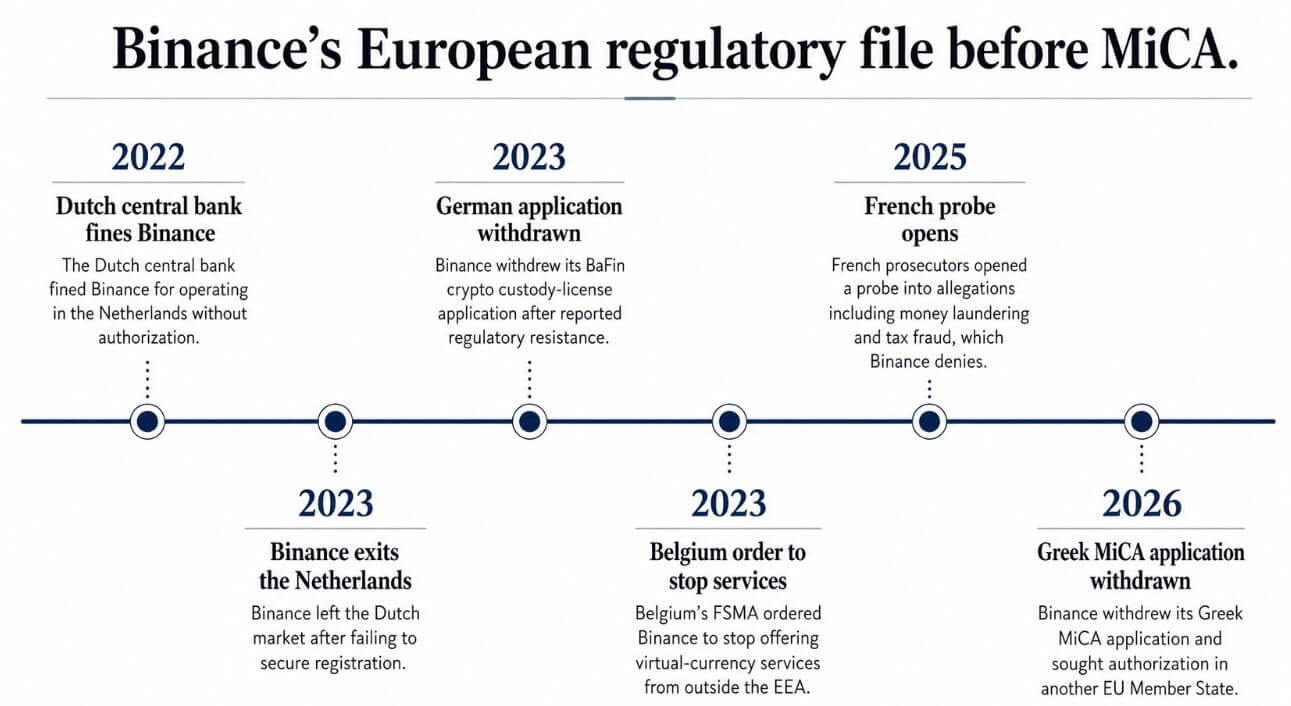
Binance withdrew its MiCA application in Greece after reported resistance and told users the absence of a formal decision before the transition deadline forced it to seek authorization elsewhere.
Reports noted that talks with regulators in Ireland and Latvia had also encountered friction, though Binance maintains that Greece was its only formal application.
ESMA has since directed unauthorized crypto-asset service providers to stop onboarding new EU clients and restrict existing services to exit and withdrawal activity.
A crypto-asset service provider license under MiCA is a fitness test administered by a national regulator, who, upon approving the applicant, extends that approval to all 27 EU Member States through passporting.
That regulator certifies Binance’s management body, qualifying shareholders, AML controls, custody systems, client-asset segregation, internal governance, and group structure as sound enough to operate without borders.
Article 62 of MiCA spells out exactly what applicants must document. Article 63 gives national competent authorities explicit grounds to refuse authorization when the management body threatens sound and prudent management, client interests, or market integrity, or poses a serious risk of money laundering and terrorist financing.
Regulators can also consult AML authorities and financial intelligence units before granting any license. That architecture makes Binance’s history the primary licensing evidence that regulators weigh before any authorization decision.
| MiCA licensing area | What the regulator must assess | Why Binance is harder to approve |
|---|---|---|
| Management body | Good repute, competence, sound and prudent management | CZ stepped down, but questions remain around influence and governance culture |
| Qualifying shareholders | Ownership, control, beneficial-owner risk | Zhao remains a major beneficial owner |
| AML/CFT controls | Money-laundering and terrorist-financing risk | DOJ, FinCEN, and OFAC settlements are directly relevant |
| Custody and client assets | Safeguarding, segregation, operational resilience | A passported license would apply across the EU |
| Group structure | Clear legal entities and supervisory access | Belgium previously flagged uncertainty around Binance entities |
| Market integrity | Systems to prevent abuse and protect clients | Regulators must defend approval to the whole bloc |
A record that follows
In November 2023, the US Department of Justice announced that Binance pleaded guilty and agreed to pay more than $4 billion to resolve violations of the Bank Secrecy Act, money transmission, and sanctions, while Changpeng Zhao separately pleaded guilty to failing to maintain an effective AML program.
Treasury’s FinCEN settlement reached $3.4 billion and OFAC’s $968 million, both accompanied by monitorship and compliance undertakings.
A European regulator assessing Binance under MiCA must weigh that record as active evidence.
The DOJ and Treasury findings directly address the same controls that MiCA requires regulators to evaluate before authorizing passporting rights: AML systems, sanctions screening, management accountability, and group governance.
Binance argues that it has since rebuilt its compliance infrastructure, employing roughly 1,500 compliance staff and having no outstanding MiCA issues. The regulator’s question is whether that rebuild is supported by evidence or merely asserted.
Europe’s pre-MiCA history with Binance gave regulators in Greece, Ireland, and Latvia a file to consult as the company searched for an authorization route, and before any regulator had to make a bloc-wide licensing call.
Binance exited the Netherlands in 2023 after failing to register, following a fine from the Dutch central bank for operating without authorization. In Germany, the company withdrew its BaFin custody-license application after regulators reportedly made clear they would not grant it.
Belgium’s FSMA ordered Binance to stop providing virtual-currency services from outside the European Economic Area, noting that Binance had not demonstrated which legal entities were offering services or whether they were properly authorized.
The FSMA also pointed to Binance’s own terms, which referenced 27 corporate entities, 19 of them outside the EEA. French prosecutors opened a judicial probe in 2025 into allegations of money laundering and tax fraud, which Binance denied.
MiCA consolidates that accumulated record into a single authorization decision that cannot be reversed at the border.
The CZ issue
Zhao stepped down as CEO in November 2023 as part of the DOJ settlement, but has remained a major beneficial owner, and Reuters reported that European regulators were examining his continued influence over the company.
Binance’s EU regional head, Gillian Lynch, told Reuters that Zhao is fully removed from company management.
MiCA’s fitness standards go beyond job titles: they require regulators to assess whether management and qualifying shareholders exercise effective control in a way consistent with sound governance, client protection, and market integrity.
A European authority approving Binance must document and supervise a group structure that proves the EU entity is insulated from informal control, reputational contagion, or group-level interference from outside the bloc.
MiCA’s architecture places CASP authorization with the national competent authority, coordinated through AML/CFT consultation channels and ESMA guidance.
The ECB’s explicit opinion role under the regulation applies to asset-referenced token issuers when monetary policy, payment systems, or financial stability are at stake, and it carries no equivalent lane for ordinary exchange authorization.
The ECB has separately advocated for stronger EU-level oversight of systemically important cross-border firms, an institutional reform position that addresses supervisory architecture.
France, Italy, and Austria have each warned that differences in national supervision could allow crypto firms to choose the regulator that imposes the lightest scrutiny.
French officials have explicitly described regulatory shopping as a search for the weakest link. A Greek, Irish, or Latvian regulator approving Binance would carry a bloc-wide political judgment, and would absorb reputational exposure if that decision later proved wrong.
Reports noted that regulators in Ireland, Latvia, and Greece coordinated closely, pointing to a collective supervisory posture.
Two futures
If any EU Member State approves Binance after the company implements verifiable governance reforms, MiCA serves as a normalization path for large exchanges with compliance liabilities, granting Binance EU-wide access and regulators a documented framework that can withstand scrutiny in Paris and Rome.
If no regulator accepts that burden in the near term, the outcome will be a sustained period of restricted EU activity, with Binance users directed to sell or withdraw, while competitors with existing MiCA licenses absorb European market share.
| Scenario | What happens | What regulators are signaling | Market implication |
|---|---|---|---|
| Normalization path | Binance secures MiCA authorization in another EU Member State after verifiable governance and compliance reforms | A national regulator is willing to certify that Binance’s controls, ownership, and governance are now defensible bloc-wide | Binance preserves EU access; MiCA becomes a route for large exchanges to rehabilitate |
| Gatekeeping path | No regulator accepts the political and supervisory burden in the near term | National authorities treat Binance’s past AML, governance, and group-structure issues as unresolved licensing evidence | Binance faces restricted EU activity; licensed rivals absorb users and liquidity |
Chainalysis estimated that illicit cryptocurrency addresses received at least $154 billion in 2025, with stablecoins accounting for 84% of illicit transaction volume. That backdrop gives regulators a stronger incentive to test major exchanges’ AML controls against evidence rather than assurances before granting passporting rights across the bloc.
The contest is over who bears the liability of the passport: Binance brings 300 million global users and more than 4 million EU app downloads last year, along with its compliance narrative, while EU regulators hold the authorization power and the reputational incentive to use it carefully.
MiCA’s first major credibility test is whether any national authority deems Binance’s evidence of change strong enough to stake the entire bloc’s supervisory reputation on.
The post Why Europe is struggling to give Binance the MiCA license it needs appeared first on CryptoSlate.
This articles is written by : Fady Askharoun Samy Askharoun
All Rights Reserved to Amznusa www.amznusa.com
Why Amznusa?
AMZNUSA is a dynamic website that focuses on three primary categories: Technology, e-commerce and cryptocurrency news. It provides users with the latest updates and insights into online retail trends and the rapidly evolving world of digital currencies, helping visitors stay informed about both markets.
