- Xiaomi opens reservations at JD.com for the Xiaomi Smart Storage, its first NAS, with prices starting at CNY 2,699 for a 4 TB two-bay unit
- The box pairs the same entry-level Realtek RTD1619B chip Synology used in its 2023 DS223 models with more generous RAM and faster networking than what Synology offered, in addition to an HDMI port
- The China-only launch gets considerably cheaper per terabyte as one moves up the storage ladder and currently ships in three different trims (4TB, 8TB, and 16TB)
Xiaomi has opened reservations on JD.com for its Xiaomi Smart Storage, its first Network Attached Storage (NAS) device, ahead of general availability, running from August 27 to September 26 2026.
The reservations follow an earlier crowdfunding phase, Xiaomi’s usual route to market in China for new product categories, which rewards the urgency and scarcity that often come with steep discounts on its products.
Three configurations are listed for the Smart Storage NAS, all bundled with drives out of the box: the entry model is CNY 2,699 for 4 TB, made up of two 2 TB hard disks; the middle option is CNY 3,499 for 8 TB; and the top configuration is CNY 5,499 for 16 TB.
A small, capable NAS with a competitive price tag in tow
The Xiaomi Smart Storage NAS is priced extremely competitively when you factor in US NAS drive prices. Its baseline 4TB SKU, which uses 2 x 2TB HDDs, costs ~$402, while the 8TB and 16TB trims, both using a similar dual-HDD configuration, cost $521 and $818, respectively (converted using Google’s published mid-market rates).
For context, one of the cheapest 8TB NAS drives on Amazon costs about $250, and the highest-end Xiaomi offering includes two of these, suggesting you get a capable NAS without drives for about $300 at the top end of the offering.
The math is even more skewed when one considers that two 2TB NAS HDDs cost nearly as much as the entry-model NAS offering, making Xiaomi’s offering essentially free, at least by US standards once you deduct the cost of storage.
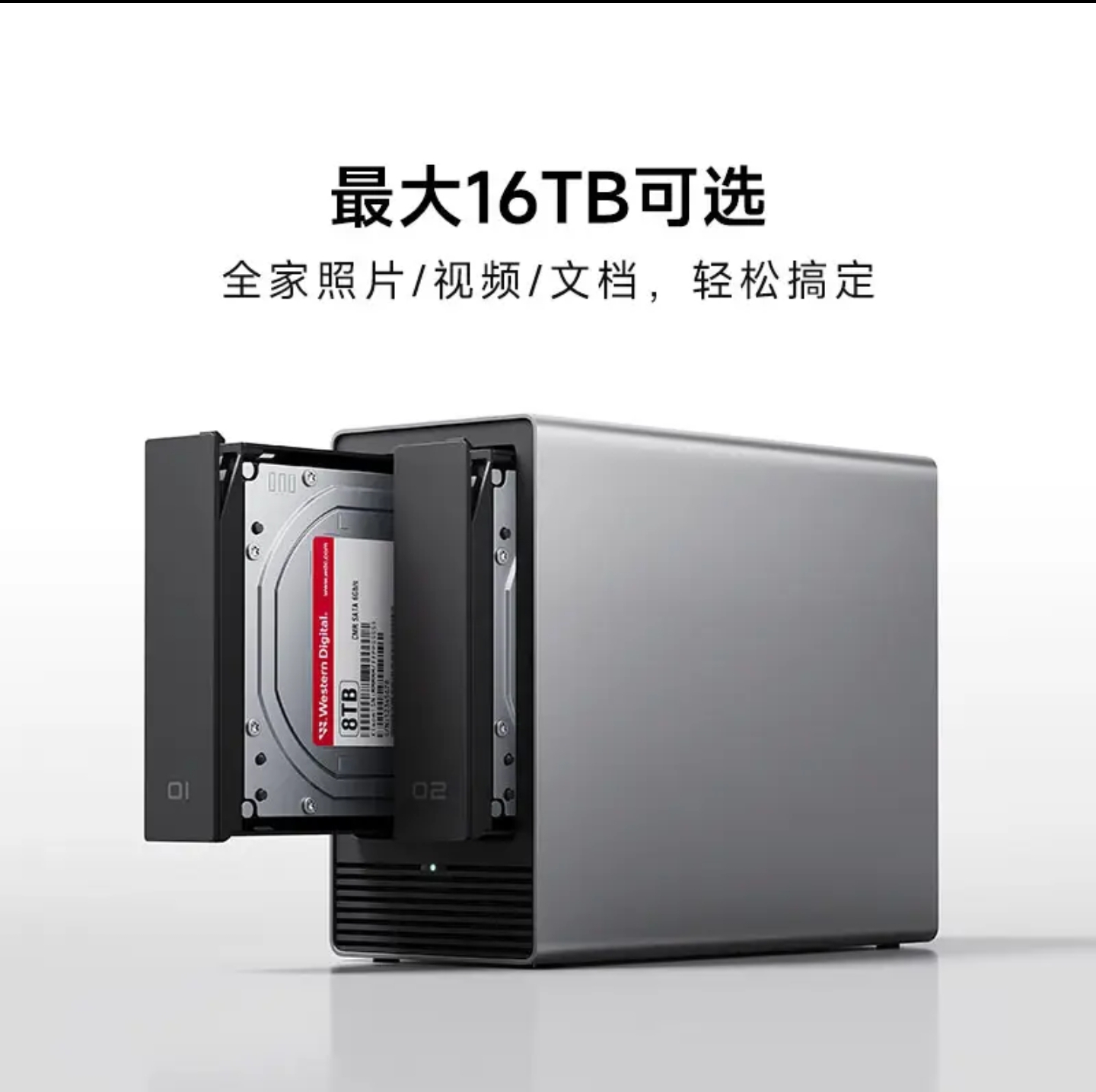
The dual-bay unit is small compared to other NAS offerings, at 200.5 by 85 by 161 mm and about 2.3 kg, wrapped in an aluminum alloy frame. Its two SATA bays accept either 3.5-inch or 2.5-inch drives, and it runs a Realtek RTD1619B quad-core ARM processor with 4 GB of RAM and 32 GB of onboard storage, plus 2.5-gigabit Ethernet, HDMI, and USB-A.
The underlying RTD1619B isn’t new: it is the same quad-core Cortex-A55 running at 1.7 GHz that Synology put in the DS223 and DS223j, its entry-level two-bay boxes, back in 2023. Anyone expecting Xiaomi’s first NAS to arrive with something exotic will be disappointed.
That said, Xiaomi has been noticeably more generous with the chip than Synology was. The DS223j shipped with 1 GB of RAM and the DS223 with 2 GB, both over a single gigabit Ethernet port. Xiaomi gives users 4 GB and a 2.5-gigabit port, plus an HDMI output that neither Synology model has. This makes it a meaningfully better configuration on the same foundation, and the HDMI port makes sense since the Realtek part descends from the company’s media processor line and supports media playback.
Xiaomi advertises a relatively modest maximum capacity of 60TB (2 x 30TB drives) and also sells a companion UPS accessory for 349 CNY. Xiaomi’s competitors have been advertising 124 TB and 132 TB support on similar hardware. The reservation window for Chinese customers interested in grabbing it closes on August 27. Independent testing and any verdict on the software that Xiaomi integrated will have to wait until units are in reviewers’ hands, however.
This articles is written by : Fady Askharoun Samy Askharoun
All Rights Reserved to Amznusa www.amznusa.com
Why Amznusa?
AMZNUSA is a dynamic website that focuses on three primary categories: Technology, e-commerce and cryptocurrency news. It provides users with the latest updates and insights into online retail trends and the rapidly evolving world of digital currencies, helping visitors stay informed about both markets.
