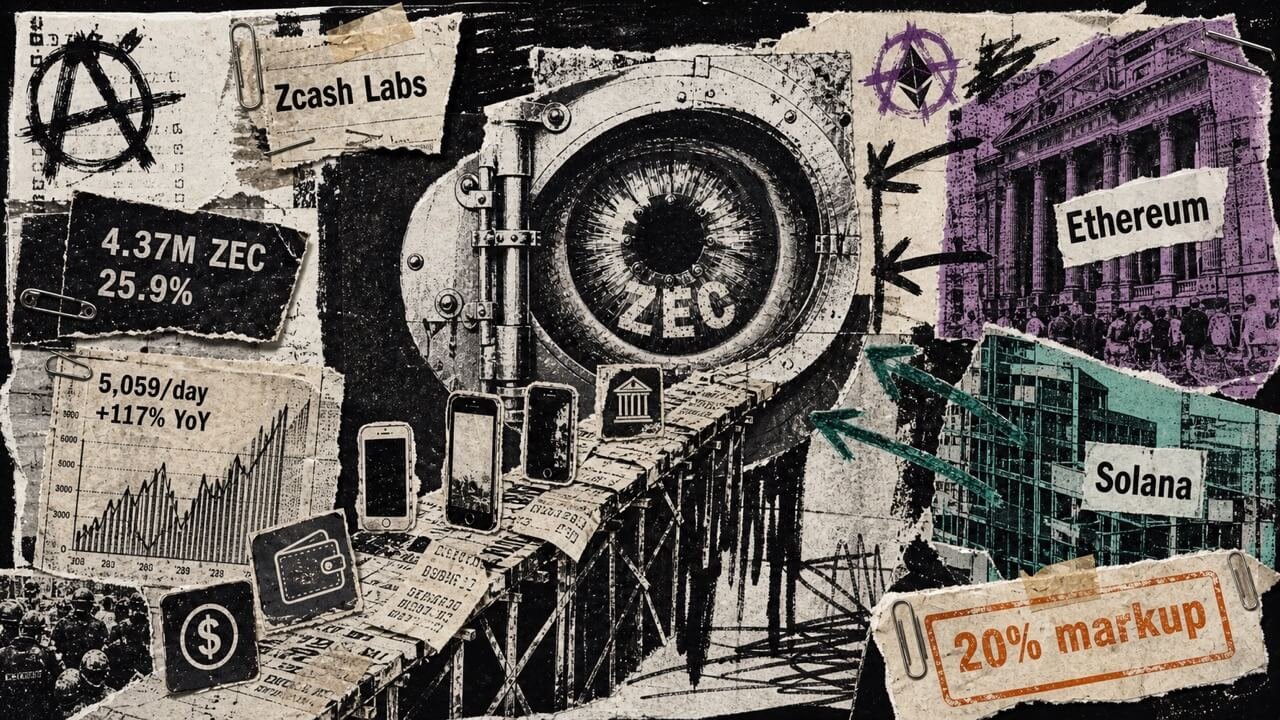
Zcash Labs launched Aug. 6 to move Zcash deeper into business and institutional use. The independent group is focused on integrations, infrastructure, and adoption projects for companies that want to use ZEC.
Zcash Labs will front project costs and later seek retroactive reimbursement from ZEC holders with a 20% markup. Its first supported project, zcashtocash, connects ZEC with Venmo, Revolut, Cash App, Chime, Monzo and Zelle across more than 100 geographies.
Ethereum and Solana are pushing confidentiality into larger financial networks. Zcash now has to compete on distribution as aggressively as it has competed on cryptography.
Zcash is spreading adoption work
All Electric Coin Company employees resigned in January during a governance dispute with Bootstrap. The former ECC team later formed ZODL, carrying wallet and protocol work into a new entity.
A Cypherpunk Technologies SEC filing states that Zashi wallet technology and related intellectual property were transferred to the new group. The Z.cash domain and official Zcash social accounts moved to the Zcash Foundation.
ZODL raised more than $25 million on March 9 from backers including a16z crypto, Winklevoss Capital, Coinbase Ventures, Maelstrom and Chapter One. Zcash Labs now handles a different part of the stack, centered on commercial integrations, infrastructure and financing.
| Entity | Role after reorganization | Key assets / focus | Strategic function |
|---|---|---|---|
| Zcash Foundation | Community stewardship | Z.cash domain, official social accounts, ecosystem assets | Governance and ecosystem continuity |
| ZODL | Wallet and protocol development | Zashi wallet technology, related IP, former ECC team | Technical development and product execution |
| Zcash Labs | Commercial integrations and infrastructure | Business integrations, infrastructure services, upfront financing | Adoption and institutional distribution |
| ZEC holders | Retroactive funding authority | Reimbursement votes for completed work | Decides whether Labs recovers capital plus markup |
Five former senior Ethereum Foundation researchers launched Ethlabs in late June as an independent nonprofit focused on institutional adoption, settlement, interoperability and infrastructure.
The move places practical adoption work outside the Ethereum Foundation through a specialized organization.
EthSystems launched July 14 from the team behind the Ethereum Foundation’s Institutional Privacy Task Force. The company builds confidential systems for institutions using Ethereum.
Zcash Labs introduces a funding mechanism based on retroactive approval, in which the group pays upfront and later asks ZEC holders for reimbursement plus a 20% premium.
The model recycles capital when holders approve repayment, leaving Zcash Labs to bear the loss when they reject it.
Ethereum and Solana are moving towards confidentiality
The Ethereum Foundation’s privacy work spans protocol confidentiality, payments, identity, tokenized assets, funds, trading, oracles, and compliance. EthSystems gives institutions a dedicated implementation layer for that work.
Solana’s March 2026 privacy report described encrypted balances, zero-knowledge anonymity, and multiparty confidential computing for payroll, institutional trading, supply-chain consortia, and dark pools.
Those approaches bring confidentiality closer to users who already hold assets, liquidity, and applications on Ethereum or Solana. Zcash now has to give users a reason to move capital into a network where privacy sits at the center of the product.
| Network | Privacy approach | Institutional angle | Competitive advantage | Zcash risk |
|---|---|---|---|---|
| Zcash | Privacy-native money | Shielded ZEC, wallets, fiat rails, integrations | Strongest privacy identity | Must pull users into its own ecosystem |
| Ethereum | Confidentiality as institutional infrastructure | Tokenized assets, funds, trading, compliance, identity | Deep liquidity and institutional footprint | “Good enough” privacy may stay on Ethereum |
| Solana | Programmable confidentiality | Payroll, trading, dark pools, encrypted balances, private payments | High-throughput app ecosystem | Privacy becomes an app feature, not a separate network |
| Zcash Labs | Distribution layer | Business integrations, payment apps, infrastructure | Converts privacy into usable rails | Model depends on adoption and retroactive funding |
ZEC Stats showed 4.37 million ZEC in shielded pools on Aug. 12, equal to 25.9% of supply and about $2.1 billion in value. Shielded transactions averaged 5,059 per day, up 117% from a year earlier.
Recent third-party data put the Grayscale Zcash Trust near $190 million in assets under management. The Zcash Foundation said Jan. 14 that the SEC closed a review tied to a 2023 subpoena and issued no enforcement recommendation.
The distribution task now sits in wallets, fiat access, payment apps, custodians, exchanges, and business integrations. zcashtocash provides Zcash Labs with an early test, as its usefulness can be measured by actual movement between ZEC and mainstream payment apps.
Zcash’s specialist moat now depends on distribution
In the bull case, the funding model proves repeatable. Zcash Labs finances useful integrations, ZEC holders reimburse the work with the 20% markup, and the group recycles that capital into more access points.
Higher zcashtocash volumes across Venmo, Revolut, Cash App, Chime, Monzo and Zelle would give the first supported project a measurable record of adoption. More custodians, exchanges, payment processors and institutional counterparties would extend that reach into professional markets.
A sustained increase in the current 25.9% shielded share would indicate that broader access is feeding into Zcash’s native privacy layer. Stronger institutional demand could also be evident in products such as the Grayscale Zcash Trust.
In the bear case, Zcash Labs finances integrations that attract little usage or struggles to recover its upfront capital through retroactive grants. Rejected requests would reduce the money available for future projects and weaken the model’s ability to keep funding new access points.
| Indicator | Current / starting point | Bullish signal | Bearish signal |
|---|---|---|---|
| Shielded ZEC supply | 4.37M ZEC / 25.9% of supply | Shielded share rises as access improves | New integrations do not increase shielded usage |
| Shielded transaction activity | 5,059 per day, up 117% YoY | Sustained growth in private transaction volume | Activity fades after privacy narrative cools |
| zcashtocash usage | First Labs-supported project | Real flows through Venmo, Revolut, Cash App, Chime, Monzo, Zelle | Integrations exist but see limited transaction demand |
| Retroactive grant approvals | New 20% markup funding model | ZEC holders reimburse completed work repeatedly | Rejections reduce Labs’ ability to recycle capital |
| Institutional access | Grayscale Zcash Trust near $190M AUM | Custodians, exchanges, funds and payment firms add ZEC support | Institutions choose Ethereum/Solana confidentiality instead |
Ethereum and Solana would gain more room to satisfy institutional confidentiality needs inside networks that already hold deeper liquidity and broader application activity. Zcash could preserve stronger privacy properties while still losing commercial ground if businesses adopt confidentiality that fits their existing infrastructure.
Zcash’s next test is distribution, measured by how quickly the network can turn privacy into wallets, fiat access, business integrations, and institutional liquidity before Ethereum and Solana fold confidentiality into their broader financial stacks.
The post Zcash is borrowing crypto’s new institutional playbook as privacy goes mainstream appeared first on CryptoSlate.
This articles is written by : Fady Askharoun Samy Askharoun
All Rights Reserved to Amznusa www.amznusa.com
Why Amznusa?
AMZNUSA is a dynamic website that focuses on three primary categories: Technology, e-commerce and cryptocurrency news. It provides users with the latest updates and insights into online retail trends and the rapidly evolving world of digital currencies, helping visitors stay informed about both markets.
