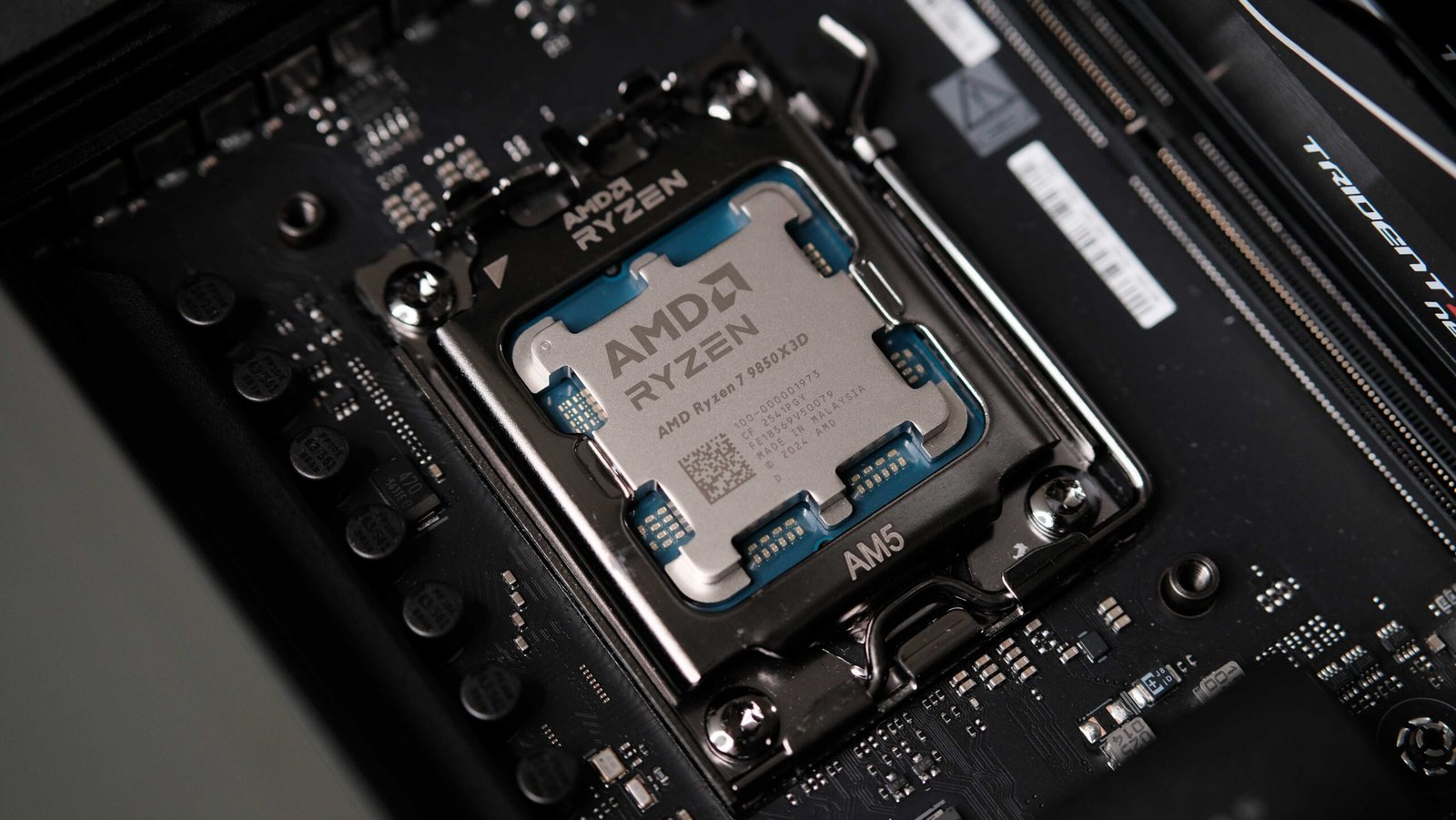
AMD’s best gaming CPUs have eight cores. Its next generation could pack twelve into the same kind of chiplet, making every single one of them faster.
AMD’s Zen 6 architecture puts 12 full-performance cores and 48MB of shared L3 cache on a single chiplet, up from eight cores and 32MB with Zen 5. That’s a 50 percent jump in both, and AMD is rebuilding the cores themselves to squeeze more performance out of every clock cycle.
The company revealed the finer details during a technical deep-dive into its next-generation Epyc “Venice” server processors. The next generation of Ryzen processors hasn’t been announced yet, but both families share the same underlying Zen 6 architecture. And for gamers, the implications go well beyond stuffing more cores onto a spec sheet, though that’s obviously fantastic.
Twelve cores, one chiplet
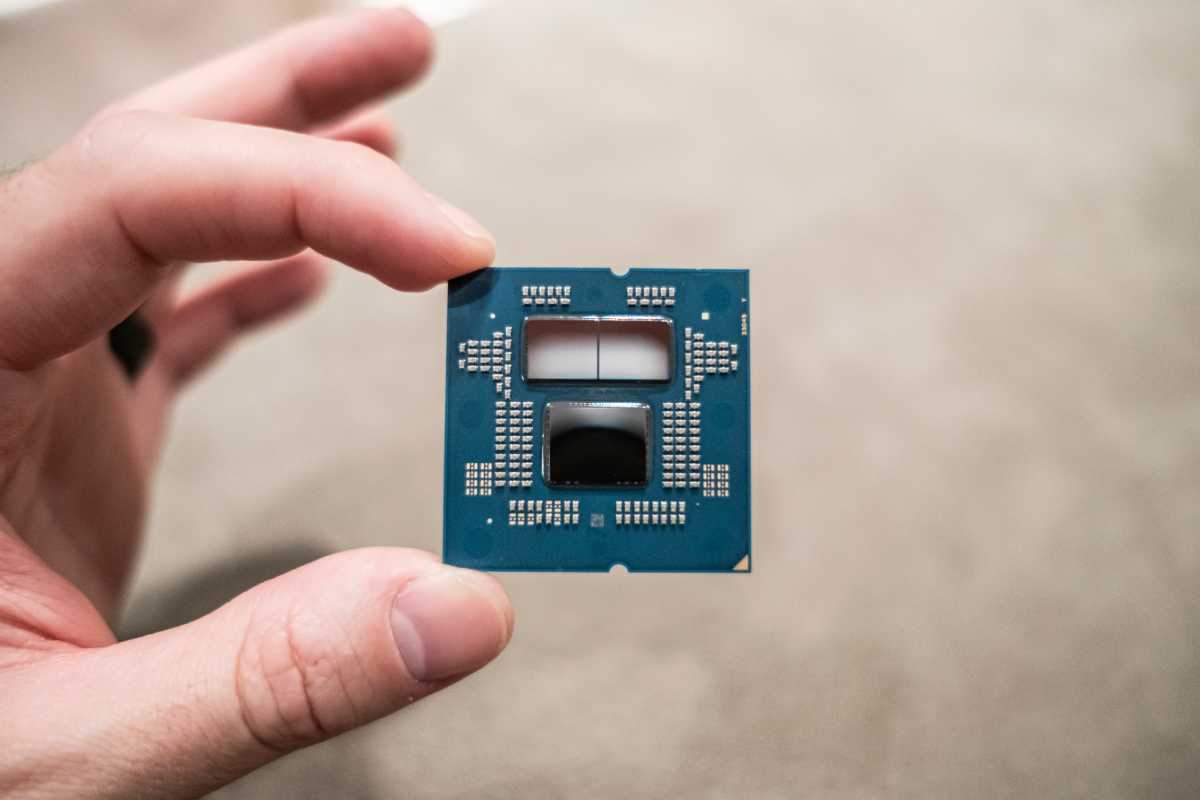
A core complex die (CCD) is a group of CPU cores sharing a pool of fast L3 cache, which keeps frequently used data close instead of forcing trips to slower system memory.
Today’s 12-core Ryzen processors need two CCDs because Zen 5 fits only eight cores into each one. That works, but communicating between separate chiplets takes longer than communicating within one. As a result, games with tightly connected threads running across both CCDs can pay a latency penalty.
Adam Patrick Murray / Foundry
Zen 6 changes the equation. With 12 cores sharing 48MB of L3 cache, a future 12-core Ryzen could fit entirely on one CCD. That’s 50 percent more cores and cache than Zen 5, though the cache-per-core ratio remains unchanged at 4MB.
Games capable of keeping more than eight cores busy could benefit without spreading that work across two CCDs. Games already running their critical threads on one CCD of a dual-chiplet processor, however, wouldn’t necessarily benefit from the new arrangement.
There’s another potential advantage for future Ryzen X3D processors, which blend Ryzen cores with integrated ultra-fast V-Cache on-die. AMD’s dual-chiplet X3D processors need scheduling logic to steer games toward the cores with the most cache. A single cache-rich CCD with twelve cores could simplify that balancing act.
Zen 6’s design also opens the door to 24-core Ryzen processors using two CCDs, as I explored in my earlier look at five clues to Zen 6’s future.
More cores aren’t the whole story
AMD’s architectural improvements go much deeper than core counts.
The company says Zen 6 delivers a substantial IPC uplift, meaning each core can accomplish more work per clock cycle. Its technical slides show approximately 27 percent higher geometric-mean IPC for the denser Zen 6c variant across AI and server workloads—not a gaming benchmark or a measured improvement for full-performance Zen 6 cores, but even so, the changes to the underlying architecture are extensive.
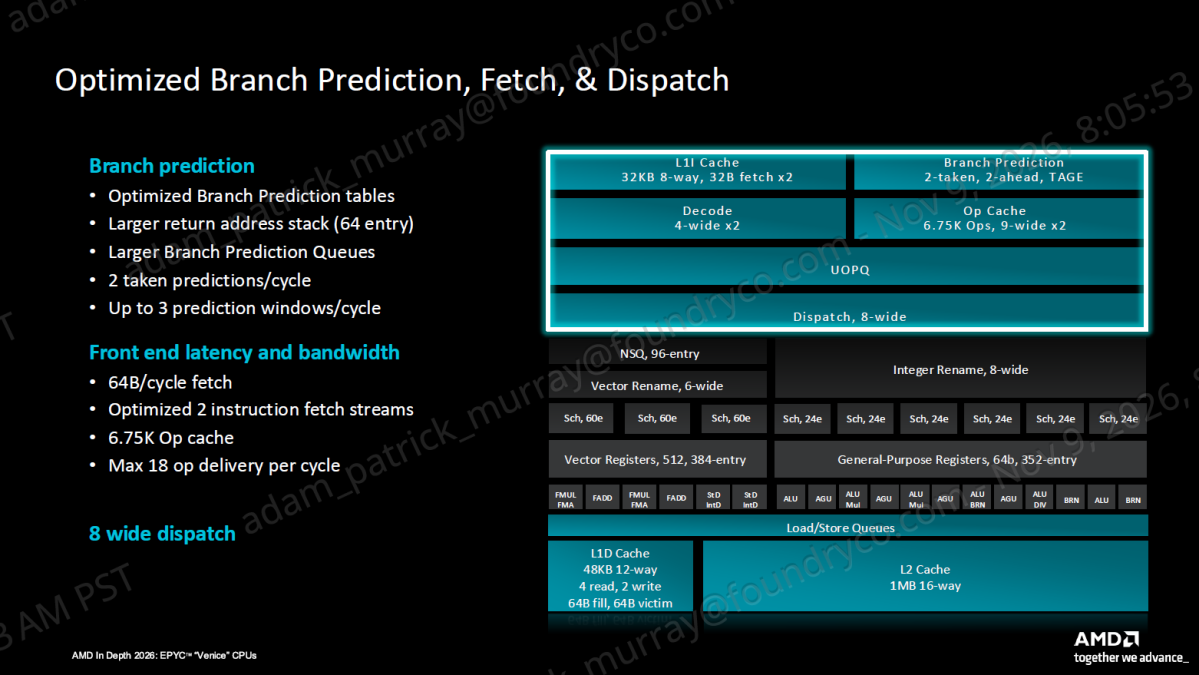
Zen 6 improves branch prediction with larger prediction queues, a 64-entry return-address stack, and the ability to predict two taken branches per cycle. In practical terms, that means the CPU has more sophisticated tools for anticipating the instructions it needs next. When it guesses wrong, AMD says the architecture can recover faster, reducing wasted work.
The operation cache grows to roughly 6,750 operations, while the front end can deliver up to 18 operations per cycle. Combined with greater instruction fusion and expanded execution resources, these changes are designed to keep the cores better supplied with useful work.
For gaming, that could be just as important as adding more cores. The vast majority of games still depend heavily on the performance of a handful of threads. Better branch prediction, faster recovery, and more efficient instruction execution can improve performance even when those extra Zen 6 cores sit largely idle.
AMD is also manufacturing Venice using TSMC’s 2nm process, targeting improved efficiency and higher maximum clock speeds in certain server configurations. The company hasn’t confirmed the corresponding Ryzen specifications, but all previous Ryzen and Epyc generations used the same underlying Zen architectures.
Now imagine 144MB of 3D V-Cache
AMD’s Venice-X server design offers another tantalizing tease: 144MB of L3 cache per 12-core CCD, combining 48MB of built-in cache with 96MB of stacked 3D V-Cache. For comparison, today’s eight-core Ryzen X3D chips offer 96MB of total L3 cache.
AMD hasn’t announced a 144MB Ryzen X3D processor. But Venice-X demonstrates that Zen 6 can pair 12 full-performance cores with a massive shared cache, the same approach that’s made AMD’s X3D processors so effective in cache-sensitive games. A larger L3 cache keeps more game data close to the CPU, reducing stuttery trips out to slower system memory. It’s the secret weapon behind Ryzen X3D’s audacious gaming successes.
A future single-CCD, 12-core Ryzen X3D could combine that cache with four additional full-performance cores and Zen 6’s architectural improvements. And unlike today’s dual-chiplet Ryzen 9 X3D processors, it wouldn’t need to steer gaming workloads between separate chiplets with different cache configurations.
That could make one of AMD’s most frustrating tradeoffs much less painful: choosing between the straightforward gaming advantages of an eight-core X3D processor and the extra cores of a Ryzen 9.
Not every game benefits equally from more cache or more cores. Clock speeds, power limits, scheduling, and AMD’s eventual consumer implementation for Zen 6-based Ryzen X3D chips will determine how well the pieces come together. But this sounds like exciting stuff on paper.
The best of both worlds?
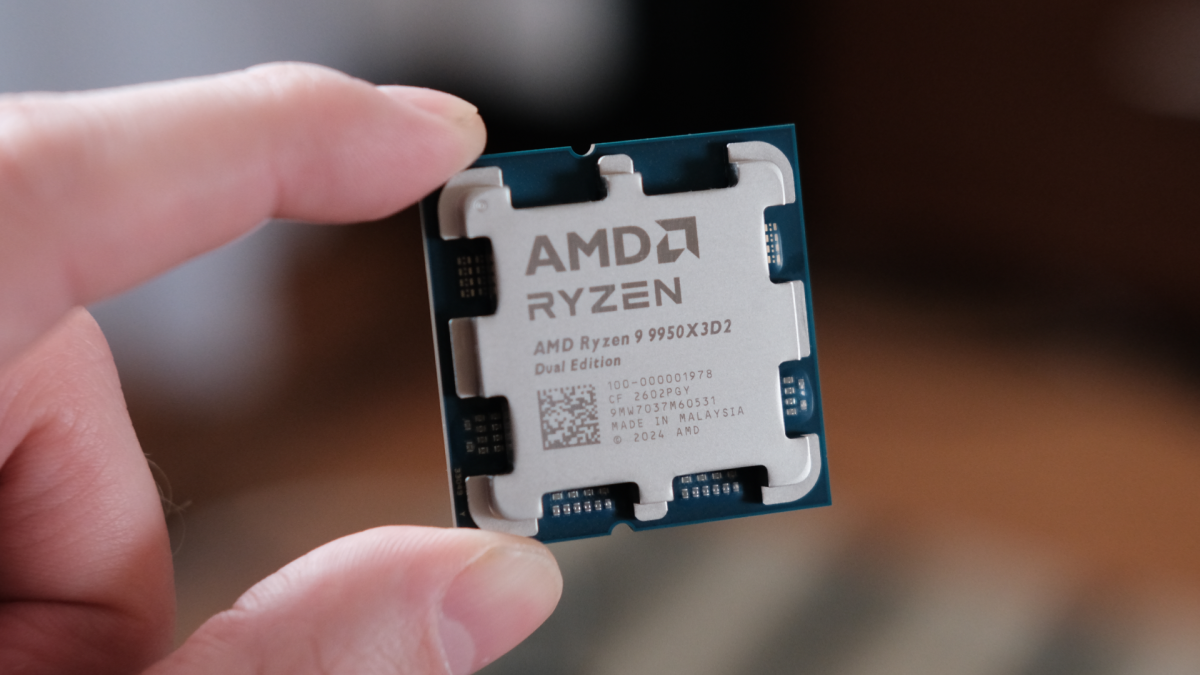
AMD’s eight-core X3D processors have already proved that clever architecture can outperform brute-force core counts in games. Zen 6 could preserve the advantages of that single-chiplet design while adding four cores, more shared cache, and stronger execution machinery.
Foundry
We won’t know the real gaming gains until independent Ryzen benchmarks arrive. The server IPC results aren’t gaming predictions, and the architectural improvements won’t eliminate every source of latency. But the prospect is damned intriguing: AMD’s next great gaming CPU might be a twelve-core workhorse that no longer needs a second chiplet to get the job done.
This articles is written by : Fady Askharoun Samy Askharoun
All Rights Reserved to Amznusa www.amznusa.com
Why Amznusa?
AMZNUSA is a dynamic website that focuses on three primary categories: Technology, e-commerce and cryptocurrency news. It provides users with the latest updates and insights into online retail trends and the rapidly evolving world of digital currencies, helping visitors stay informed about both markets.
